fitness tips

Auto Added by WPeMatico

You Can Do a Muscle-Up. Here’s How

You Can Do a Muscle-Up. Here’s How Unless you’re already a trained gymnast, bar muscle-ups are one of the most challenging bodyweight movements you can attempt. In addition to requiring significant core and upper-body strength, muscle-ups demand excellent mobility, body awareness, coordination, and timing. If you’re determined to add muscle-ups to your gym repertoire, know that there’s a right and wrong way to develop this skill. The wrong way: Repeatedly swinging and slamming your body against the bar until you’re fatigued, frustrated, and possibly injured. The right way: A muscle-up progression. A muscle-up progression is a series of increasingly difficult movements that gradually develops your muscle-up technique while building your strength. Each stage of the progression includes benchmarks indicating your readiness to move on to the next drill within the progression. The final stage is, of course, a muscle-up safely executed with confidence and impeccable form. 6-Step Bar Muscle-Up Progression Dr. John Gallucci, Jr., MS, ATC, PT, DPT, CEO of JAG Physical Therapy, explains that a muscle-up is actually a series of smaller movements strung together: Kip swing Knee raise Leg raise Chest-to-bar pull-up Triceps dip To do a muscle-up, you must be comfortable performing each of these movements repetitively. That’s where the muscle-up progression comes in. Developed with input from Gallucci and Jeff Waters, registered USA Boxing coach and owner of Watters Performance, the following muscle-up progression starts at a beginner level. Depending on your gymnastic experience and current strength levels, you may be able to skip ahead. Step 1: Hanging knee/leg raise Grab a pull-up bar with an overhand grip that’s slightly wider than shoulder-width. Hang at arm’s length with your arms straight (a position known as a dead hang) and your legs straight and together. Bend your knees 90 degrees and lift them to hip level. Hold for one second, then return to the starting position. Once you’re able to perform three sets of 10 reps, perform the same movement keeping your legs straight so that your body creates an L shape. Once you’re able to perform three sets of 10 reps of straight-leg raises, move on to the next step. Tip: “Ensure that you’re not swinging and using momentum to get your legs up, and all the work is coming from the hip flexors and the core,” Gallucci says. Step 2: Assisted chest-to-bar pull-up Loop one end of a large resistance band around the pull-up bar. Grab the bar with an overhand grip that’s slightly wider than shoulder-width and place one foot in the other end of the resistance band. Hang at arm’s length with your legs straight and core and glutes engaged. Without swinging or kipping (using momentum to propel you upward), engage your lats and squeeze your shoulder blades together as you pull your chest to the bar. Pause, and then lower yourself back to a dead hang. Tip: “Start with a thicker band,” Watters says. “If you can do 10 full pull-ups, use a thinner band. Over time, keep working your way down until you can do 10 strict pull-ups with the thinnest band. Then move on.” Step 3: Strict chest-to-bar pull-up Grab a pull-up bar with an overhand grip that’s slightly beyond shoulder width. Hang at arm’s length with your arms straight, and your ankles crossed behind you. Without swinging or kipping, engage your core, glutes, and lats as you squeeze your shoulder blades together and pull your chest to the bar. Pause, and then lower yourself back to a dead hang. Once you can do three sets of 10 reps, move on. But continue to practice chest-to-bar pull-ups while working on new skills. Tip: “At this stage, it’s important to also be working on the ‘push‘ feature that you use in a muscle-up,” Watters says. He suggests incorporating push-ups into your training plan, including leverage push-ups, in which you lower yourself all the way to the ground and temporarily lift your arms before pushing up into plank in order to eliminate any momentum from the movement. “Start from the floor position to halfway up, then lower yourself back to the ground. This is the hardest part of the push, which is why we emphasize it,” he says. Step 4: Triceps dip Grab the handles of a dipping station and jump or step up to the starting position: feet off the floor, arms straight, and ankles crossed. (To make the movement easier, you can loop a large resistance band across the handles and place your knees on it.) Keeping your forearms vertical and elbows tucked in (not flared), allow your torso to lean forward as you lower your body until your elbows form about a 90-degree angle. Reverse the movement, returning to the starting position. Once you can do three sets of 10 reps, move on. Step 5: Kip swing Grab a pull-up bar with an overhand grip that’s slightly wider than shoulder-width. Hang at arm’s length with your arms straight and your legs straight and together. Assume a hollow-body position: engage your core and lats to flex (round) your spine and tilt your pelvis back (tuck your tailbone). Use the shoulders to thrust your chest forward and arch your spine, allowing your legs to swing behind you. Use your shoulders, lats, and core to swing back into a hollow-body position and begin to pull up in the same way you do for chest-to-bar pull-ups. Once you’re able to complete three sets of 10 reps of kip swings during which your chest meets the level of the bar, progress to a full muscle-up. Tip: Make sure you’re using your shoulders, not your hips, to generate the swing. Step 6: Muscle-up Grab a pull-up bar with an overhand grip that’s slightly wider than shoulder-width. Hang with your arms straight and your core and glutes engaged. Initiate a kip swing: starting from a hollow-body position, use the shoulders to thrust your chest forward and arch your spine. Then, use your shoulders, lats, and core to swing back into a hollow-body position. (Once you’re behind the bar, lean back and

You Can Do a Muscle-Up. Here’s How Read More »

The Weekly Roundup: Your Go-To Guide For Everything You May Have Missed This Week & More! 12/13-12/19

The Weekly Roundup: Your Go-To Guide For Everything You May Have Missed This Week & More! 12/13-12/19 Welcome to Ben Greenfield’s Weekly Roundup! In this weekly post, I share with you my most interesting discoveries of the The post The Weekly Roundup: Your Go-To Guide For Everything You May Have Missed This Week & More! 12/13-12/19 appeared first on Ben Greenfield Life – Health, Diet, Fitness, Family & Faith. Welcome to Ben Greenfield’s Weekly Roundup! In this weekly post, I share with you my most interesting discoveries of the The post The Weekly Roundup: Your Go-To Guide For Everything You May Have Missed This Week & More! 12/13-12/19 appeared first on Ben Greenfield Life – Health, Diet, Fitness, Family & Faith. Miguel Vences{authorlink}https://bengreenfieldlife.com/article/wkru12-13-12-19/Articles by Ben Greenfield – Ben Greenfield Fitness Discover the best life-hacking secrets for body, mind and spirit optimization, personal productivity, work-life balance, family, relationships, survival, spirituality & more! https://bengreenfieldlife.com/wp-content/uploads/2022/02/cropped-BGL-Favicon-negative-5@512-32×32.png

Read More »

How to Train Type 1 Muscle Fibers for Greater Endurance

How to Train Type 1 Muscle Fibers for Greater Endurance If your goal is to PR a marathon, climb a mountain, or crush your coworkers in the annual office plank competition, you need to understand type 1 muscle fibers and how to build them. Of the two primary types of skeletal muscle fibers, type 1 muscle fibers (a.k.a. “slow-twitch” muscle fibers) are more endurance-oriented and are crucial to steady-state exercise, high-rep strength-training sets, and isometric holds. But before we get into the specifics of how to target type 1 fibers in your workouts, let’s first take a closer look at what they are and how they function. What Are Type 1 Muscle Fibers? Compared to type 2 (fast-twitch) muscle fibers, which are larger and more powerful, type 1 muscle fibers have long contraction times (hence their “slow-twitch” moniker). As a result, they generate less force, but they’re more fatigue-resistant. That’s why they’re your body’s go-to fibers for longer-duration, steady-state activities like running and cycling, and for continuous-effort, higher-rep strength workouts like circuit training. How to Train Type 1 Muscle Fibers Every muscle contains both type 1 and type 2 muscle fibers, and everyone is born with their own unique ratio of them, says Breanne Celiberti, MS, former adjunct instructor in the Human Performance department at the University of Tampa. But with targeted training, you can favor and build one fiber type over the other. To develop your type 1 muscle fibers, focus on aerobic and endurance-oriented activities and training modalities: 1. Steady-state training Maintaining a steady pace for longer distances will hammer your type 1 fibers (as opposed to sprinting and interval training, which target type 2 fibers). 2. Resistance training Weave light-weight, high-rep sets into your routine to target your type 1 fibers. Research also shows that performing both light-weight/high-rep and heavy-weight/low-rep sets can help maximize hypertrophy (muscle building) by working both of the primary muscle fiber types. 3. Circuit training Back-to-back sets of plyometric, bodyweight, and weightlifting exercises will tax both your cardiorespiratory system and your muscles — especially your type 1 fibers. What Do Type 1 Muscle Fibers Look Like? Type 1 muscle fibers require more oxygen to produce energy than type 2 muscle fibers, so they are red. Their counterparts, type 2 muscle fibers, which are more anaerobic (oxygen-independent), are white. “Type 1 fibers are also a bit smaller,” Celiberti says. “Upon close examination, type 1 muscle fibers have higher capillary density and oxidative capacity, as well as a smaller diameter than type 2 fibers.” The post How to Train Type 1 Muscle Fibers for Greater Endurance appeared first on BODi. If your goal is to PR a marathon, climb a mountain, or crush your coworkers in the annual office plank competition, you need to understand type 1 muscle fibers and how to build them. Of the two primary types of skeletal muscle fibers, type 1 muscle fibers (a.k.a. “slow-twitch” muscle fibers) are more endurance-oriented and are […] The post How to Train Type 1 Muscle Fibers for Greater Endurance appeared first on BODi. Jenessa Connor, CPT{authorlink}https://www.beachbodyondemand.com/blog/type-1-muscle-fibersBODi BODi is a Health Esteem platform to help you embrace the person you are today so you can take action to achieve all your health and fitness goals. https://bodiblog.wpenginepowered.com/wp-content/plugins/bod-blog/assets/vendor/beachbodydigital/wordpress-core-plugins/beachbody.png

How to Train Type 1 Muscle Fibers for Greater Endurance Read More »

What Is My Body Type, and Can I Train for It?

What Is My Body Type, and Can I Train for It? In the 1940s, a University of Houston professor named William Sheldon coined the concept that all humans fall into one of three body types, or somatotypes. It was bold. It was revolutionary. It was complete nonsense. The whole notion of a three-sizes-fit-all classification system has never been supported by science. In fact, it’s been roundly renounced almost since its introduction. But that’s done little to slow the flow of misinformation, which Sheldon based largely on personal observation. Just in case you’ve forgotten or were mercifully spared awareness of this classic junk science, a brief review may be in order. What Are the 3 Different Body Types? Like a lot of us, there’s a good chance you learned about the three somatotypes in a junior high health class. And, on the surface, they probably appeared pretty reasonable. Ectomorph Ectomorphs are described as long and lean, with thin waists and little body fat or muscle mass. Weight gain can be difficult, but weight loss comes relatively easy. Imagine Zoe Saldana or Bruce Lee. Endomorph According to Sheldon, endomorphs carry plentiful reserves of body fat and muscle, making weight gain easy and weight loss consequently harder. Here, think Serena Williams or Chris Pratt (circa Parks and Recreation). Mesomorph Mesomorphs are characterized as athletic, solid, and strong — daywalkers between the other two somatotypes. Let’s go with Mark Wahlberg or Alex Morgan. Are Body Types Real? Again, Sheldon’s somatotypes are inaccurate and grossly oversimplify the human body. “Few people fit entirely into one of the classic body types,” says Trevor Thieme, CSCS. “Most people are a mishmash of them. For example, you might have the upper body of a ‘mesomorph’ and the lower body of an ‘ectomorph.’ But being able to classify your body type doesn’t really matter, because it won’t necessarily inform you about what does: how your body will respond to training.” So why is this fitness myth hard to get rid of? “I think that a lot of it has to do with the fact that most people want an easy solution when it comes to fitness and fat loss,” says Thieme. “And the idea that if you have X body type then you should focus on Y exercise type provides that.” But such thinking is backwards, says Thieme. “You need to start with your goal, because that is going to shape your training program, regardless of your ‘body type.’” Can You Change Your Body Shape? Somatotype doesn’t predict training response, which means there’s a lot you can do to change your body composition. And starting with your goal (say, getting more muscular), then working backwards to determine your optimal training plan is actually pretty freeing. It means that if you’re a classic ectomorph, you don’t have to favor distance running over pumping iron. And if you’re an endomorph, there’s no reason why you shouldn’t train for a marathon if that’s on your bucket list. The key point here is that you’ll never know what you’re capable of until you try it. But it’s important to know what is and isn’t within your control. The role of genetics To be clear, just because somatotypes aren’t predictive of performance doesn’t mean that the training field is level. Regardless of your goal or the route you take to get there, odds are that you’ll encounter others who travel it faster or slower than you, because what’s written in your DNA is still important. “There are many factors we can manipulate to our advantage depending on goals — training frequency, training intensity, what exercises we prioritize, programming periodization, nutritional factors — but it’s also important to understand some people picked the right parents,” says Tony Gentilcore, CSCS, owner of CORE, his training studio in Brookline, Massachusetts. “Some people just look at a dumbbell and they grow. Some people have to fight tooth and nail and work out a lot in order to see the fruits of their labor,” he adds. The most important factors in choosing a workout And that’s the case regardless of your ultimate goal. “But at the end of the day, what’s going to ‘work’ is anything that you actually like doing and that you’ll stick to consistently,” says Gentilcore. So tailor your training to your goals, workout preferences, time constraints, and strengths and weaknesses, advises Thieme. “Your training plan needs to be customized to you as an individual, not based on a body type category that wasn’t even created with exercise in mind.” The History of Somatotypes Sheldon didn’t even catalogue body types for fitness purposes. He was a psychologist who posited that it was possible to attach personality traits to each body type. He was more interested in how our bodies might shape our character than how they actually functioned. Sheldon hypothesized that ectomorphs are introverted, artistic, and emotionally intense. Endomorphs are jolly, relaxed, and sociable. Mesomorphs are assertive, adventurous, and competitive. If that sounds like poppycock, balderdash, or any other 1940s word for bull effluvium, it is: Sheldon’s entire motivation for his study has been thoroughly debunked. “Sheldon’s toxic eugenic views and equation of physique with destiny in the years following World War II made him increasingly unpopular,” according to a 2015 article in the Canadian Bulletin of Medical History. “The death knell of his career was dealt by his former female assistant, Barbara Honeyman Heath. Publicly denouncing his methods as fraudulent and his somatotypes inaccurate she went on to build a successful career modifying somatotyping techniques and participating in projects all over the world.” Why Does the Body-Type Myth Persist? You’d think with that kind of emphatic beatdown from the medical and fitness establishments, Sheldon’s idea of three primary body types would have gone the way of the Segway, Zune, New Coke, and Cheetos Lip Balm (yes, that was a real product). But the myth of somatotypes is surprisingly strong, as any quick Google search will tell you. For just one of far too many examples, London’s Daily Mail newspaper asserted, “Scientists say we all fit into

What Is My Body Type, and Can I Train for It? Read More »

The Weekly Roundup: Your Go-To Guide For Everything You May Have Missed This Week & More! 12/6-12/12

The Weekly Roundup: Your Go-To Guide For Everything You May Have Missed This Week & More! 12/6-12/12 Welcome to Ben Greenfield’s Weekly Roundup! In this weekly post, I share with you my most interesting discoveries of the The post The Weekly Roundup: Your Go-To Guide For Everything You May Have Missed This Week & More! 12/6-12/12 appeared first on Ben Greenfield Life – Health, Diet, Fitness, Family & Faith. Welcome to Ben Greenfield’s Weekly Roundup! In this weekly post, I share with you my most interesting discoveries of the The post The Weekly Roundup: Your Go-To Guide For Everything You May Have Missed This Week & More! 12/6-12/12 appeared first on Ben Greenfield Life – Health, Diet, Fitness, Family & Faith. Miguel Vences{authorlink}https://bengreenfieldlife.com/article/wkru12-6-12-12/Articles by Ben Greenfield – Ben Greenfield Fitness Discover the best life-hacking secrets for body, mind and spirit optimization, personal productivity, work-life balance, family, relationships, survival, spirituality & more! https://bengreenfieldlife.com/wp-content/uploads/2022/02/cropped-BGL-Favicon-negative-5@512-32×32.png

Read More »

7 Benefits of Foam Rolling (Complete Beginner’s Guide)

7 Benefits of Foam Rolling (Complete Beginner’s Guide) Discover 7 amazing benefits of foam rolling for muscle recovery, flexibility, and pain relief. This complete beginner’s guide teaches you how to start and maximize results! Foam rolling has so many benefits and is popular amongst physical therapists and athletes to maximize muscle recovery. True to the name, it’s simply a roll of foam that is used for a self-myofascial release technique, that is much more affordable and convenient than deep tissue massages. Foam rolling has gained popularity in recent years as more research reveals the incredible benefits it provides for the body. I personally try to foam roll two to three times a week and I’ve noticed a difference in my daily movement. Let’s take a look at some of the amazing benefits of foam rolling, and how to get started with this simple but powerful tool! Table of contents 1. Loosens Stiff Muscles 2. Can Reduce Stress 3. Helps Prevent Injury 4. Limits Soreness 5. Can Increase Flexibility 6. Boosts Blood Circulation 7. Can Increase Range of Motion How to Get Started Using a Foam Roller Understand the Two Main Types of Foam Rolling Techniques How To Use A Foam Roller Where to Buy Your Foam Roller Foam Rolling Exercises to Get Started With 1. Loosens Stiff Muscles One of the major benefits of foam rolling is that you can use it to loosen stiff muscles so you can get the most out of your workouts, and focus on your recovery too. Ever gone from lounging on the couch to hitting the pavement for a jog without taking the time to properly warm up? You’ve likely felt extremely stiff. Foam rolling is a great way to get blood flowing and loosen up your muscles before a workout so you feel good and your movement feels comfortable. One study conducted by the National Strength & Conditioning Association concluded that athletes who took advantage of foam rolling before exercising felt much less fatigued than those who chose not to foam roll. 2. Can Reduce Stress Foam rolling helps relax tight muscles and release tension, promoting a calming effect that can reduce overall stress levels. High levels of stress can take a toll on your health, especially if you’re trying to lose weight and get in shape. Constant stress is linked to increased hormones such as cortisol that increase appetite, promote weight gain and fat storage, and disrupt your sleep. One university study from South Korea found that foam rolling can lower levels of the stress hormone cortisol. 3. Helps Prevent Injury Another benefit of foam rolling is that it helps to improve muscle elasticity and addresses imbalances, minimizing the risk of strains and injuries during physical activity. Injury prevention isn’t just about being careful, but about being proactive. A consistent routine of stretching and foam rolling can help keep pesky and painful injuries linked with tightness and overuse, as the iliotibial band, at bay by loosening up the muscles. Studies have shown that loosening up your muscles increases the compliance of the muscle-tendon unit. This prevents the body from demanding energy absorption and release that can exceed the capacity of the muscle-tendon unit that leading to injury. 4. Limits Soreness Regular foam rolling aids in breaking up lactic acid buildup, which can reduce post-workout soreness and speed up recovery. By increasing flexibility and blood flow, foam rolling can inhibit soreness. A 2015 study conducted by the National Athletic Trainer’s Association concluded that foam rolling was significantly effective in lessening muscle fatigue and soreness. 5. Can Increase Flexibility Foam rolling releases fascial adhesions, making muscles more pliable and enhancing overall flexibility. Loosening up your muscles through foam rolling can boost their elasticity. The more flexible the muscles, the more power they can produce. In fact, a 2014 study found that foam rolling even increased an athlete’s range of motion. You can also check out my top 10 stretches to improve flexibility after middle age for more tips! 6. Boosts Blood Circulation Another benefit of foam rolling is that it stimulates blood flow, delivering oxygen and nutrients to muscles for better recovery and performance. Proper blood circulation is important on a multitude of levels. Massages work to improve circulation through the arteries, veins, and capillaries in your body, which allows them to receive more oxygen to feel refreshed. One study conducted by the National Athletic Trainer’s Association found that arterial stiffness was decreased while the vascular endothelial function was increased after using a foam roller. 7. Can Increase Range of Motion By loosening tight muscles and connective tissue, foam rolling improves joint mobility and enhances the range of motion during movement. A 2010 study from the Centers for Disease Control and Prevention concluded that the range of motion in every major joint in the body decreases with age. This can cause everyday tasks to feel painful. Decreased range of motion can also lead to injury. Foam rolling has been found to increase range of motion and, compared to static stretching before a workout, can increase muscle force according to a 2014 study published in the International Journal of Sports Physical Therapy. How to Get Started Using a Foam Roller Now that we’ve covered the benefits of roam rolling, let’s dive into how to get started with foam rolling to improve recovery, flexibility, and mobility. These beginner-friendly tips, techniques, and essential steps will help you get started with foam rolling today! Understand the Two Main Types of Foam Rolling Techniques There are two main foam rolling techniques you can use: static pressure and dynamic rolling. Static Pressure This technique involves finding a tender or tight spot in the muscle and holding the foam roller in place on that area for 20–30 seconds. The sustained pressure helps release tension, improve blood flow, and relax the muscle. It’s especially useful for addressing specific trigger points or knots. Dynamic Rolling This method involves slowly rolling the foam roller back and forth over a muscle group, typically in

7 Benefits of Foam Rolling (Complete Beginner’s Guide) Read More »

Weight Loss Motivation: Find Your ‘Why’ for Lasting Results

Weight Loss Motivation: Find Your ‘Why’ for Lasting Results Discover the key to weight loss motivation by finding your ‘why.’ Learn how aligning your goals with your personal purpose can lead to lasting results and a healthier lifestyle. What’s the main reason behind your weight loss goals? Finding your “why”—or the driving force behind your weight loss journey—is essential for staying motivated and achieving your goals. But what is it, exactly? Are you losing weight simply to improve your physical appearance, or is it something else that drives you to make healthier choices? I always tell my clients that their “why” for wanting to get healthier or lose weight needs to be tied to something deeper—having more energy, getting better sleep, improving relationships, becoming more active, or gaining clearer focus. Weight loss will be the byproduct of achieving these things. Let’s explore how to keep your weight loss motivation strong the steps for finding your “why,” setting realistic goals, creating an action plan, and staying motivated along the way. 1. Identify Your “Why” for Weight Loss It’s essential to understand why you want to make a change in your life. Identifying your “why” can help keep you motivated and focused on achieving your goals. Your “why” is the purpose behind the action that will drive you forward when times get tough. I like to call it your “purpose statement.”  Your “why” should be more than just wanting a better physique; it needs to have emotional meaning. It connects to your life values and is so much deeper than just weight loss. Weight loss is the byproduct of your new habits.  Here are a few examples: Are you looking to improve your overall health? Do you want more energy or confidence? Are you trying to stay healthy for your kids or grandchildren? Do you have medical issues that would benefit from a healthier weight? Are you sick of being tired and looking to get better sleep? No matter the incentive, figuring out why you’re striving for a transformation can assist in sustaining your dedication and keeping you on track to attaining your ambition. These deeper desires will eventually result in weight loss because you’ll change your habits to achieve them. Once you’ve identified your why (and it can’t be “weight loss”—you need something meaningful!), it’s time to determine how you will get started by setting your goals. 2. Set Realistic Goals Building realistic goals helps focus your energy and create a plan for reaching the desired outcome. Goals should be realistic, measurable, and achievable within a reasonable amount of time. Here are a few easy steps you can take toward setting realistic goals for maintaining weight loss motivation: Break Down Large Goals Into Smaller Steps To ensure that you are setting yourself up for success, it’s best to break down large goals into smaller tasks or steps. Smaller objectives can be established to make the larger goal more manageable and keep you inspired as you progress. Example: If your aim is to shed 10 pounds by the start of summer, break it down into bite-sized portions, such as losing 1-2 lbs per week for the upcoming months. Set Weekly or Monthly Mini-Goals These small successes will add up over time and help keep you on track toward achieving your overall goal. Example: Exercise three-five times a week for 20 minutes or cut out sugary snacks from your diet completely. Find Your Support System When aiming to reach objectives, consider who or what support systems you can utilize to ensure success. Examples: Consider asking for support from friends and family who can offer encouragement when needed. Join a gym with knowledgeable trainers who can provide guidance during workouts. Connect with an online community where people share their experiences related to similar objectives so that you don’t feel isolated on your journey toward success. 3. Create an Action Plan Once your goals are set and organized, it’s time to create a plan of action for maintain weight loss motivation. This is often where people stop. They set their goals but never really decide how they will actually make them happen.   Creating a solid action plan is essential to achieving any goal. Think of this as the roadmap that will help you get from where you are now to where you want to be. An action plan will lay out the daily, weekly, and even monthly tasks you need to do. It also involves a timeline for completing each step. Here are a few simple steps for creating your action plan to keep your weight loss motivation high: Create a “Stop/Start Doing” List This helps identify the habits you know you need to stop doing and creates awareness of the habits you’d like to adopt.  Example: Let’s say your goal is to eat healthier. Here is your “stop/start doing” list: During week one, eliminate added sugars from your diet. (I.e., something to stop doing.) During week two, make sure you’re getting five anti-inflammatory fruits and vegetables per day. (I.e., something to start doing.) During the following weeks, add more things to stop and start doing. You’ll create better habits as you do! Create Timelines That Help Fit in New Routines Consider how much time and effort each new habit will take to fit into your lifestyle without becoming overwhelming or too difficult to manage. Example: If your nearest gym is 30 minutes away, maybe exercising at home is a better choice. If necessary, adjust the timeline accordingly to work along with your schedule and other commitments. These are my recommendations for the best home gym equipment to workout at home! Build In Rewards Make sure you add in rewards along the way! This could be in the form of self-care after reaching certain milestones or celebrating small victories with the purchase of something you’ve wanted for a while. You decide what works for you, but make sure you celebrate the milestones because you deserve it! Monitor Your Progress Regularly monitor progress on each task

Weight Loss Motivation: Find Your ‘Why’ for Lasting Results Read More »

10 Benefits of Resistance Bands for Home Workouts

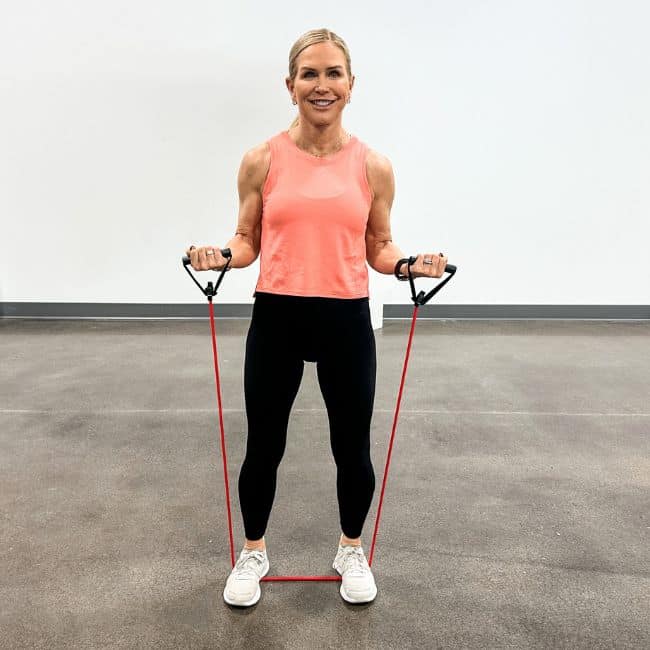
10 Benefits of Resistance Bands for Home Workouts Resistance bands are a simple but powerful strength training tool that can complement or replace dumbbells. Learn the benefits of resistance bands, how to incorporate them into your strength workouts, and which type of band to buy. I have decades of experience as a personal trainer and women’s health expert, and I’m here to tell you that resistance bands are an amazing fitness tool. I’ve seen great results myself, and with clients too. These simple, colorful bands can help transform your fitness game, whether you’re looking to enhance flexibility, build strength, or just add variety and a change of pace to your workouts. Here’s a look at the top 10 benefits of using resistance bands in your workout routine, plus which ones I recommend buying! 1. Enhances Flexibility and Mobility Resistance bands aren’t just for strength training; they’re fantastic tools for improving flexibility and mobility. Stretching with bands offers a deeper, more controlled stretch, making it easier to warm up or cool down effectively. They help target hard-to-reach areas and can support functional movement, enhancing joint range of motion, which is crucial for daily activities and overall body balance. I personally love using a long resistance band for shoulder mobility. Hold the band, one end in each hand and pull with tension in front of your body. Then take your hands and arms up and back behind your body while pulling a little tension. And then go back to the front of your body. 2. Boosts Strength Without Heavy Weights Want to build muscle without lugging around heavy weights? Resistance bands provide a challenging workout that activates muscle fibers differently than free weights. The constant tension bands provide as you push and pull works muscles throughout the entire range of motion, leading to strength gains without the need for a heavy set of dumbbells. You’ll feel the burn as you work against the resistance, whether you’re performing squats, chest presses, or rows. This resistance band squat is a great exercise to start with! 3. Activates the Core for Better Stability and Balance Another benefit of resistance bands is that when using them for exercises like squats, lunges, and rows, you naturally engage the core, improving your stability and coordination. These exercises demand control, which forces your core muscles to activate and stabilize your movements. As a result, you’ll not only tone your abs but also enhance overall body balance, making you more resilient to injury in everyday movements. This resistance band alternating glute squeeze exercise is a great exercise for focusing on your core and stability. I also recommend giving the resistance band row and the resistance band lunge move a try! 4. Perfect for Workouts On the Go One of the greatest perks of resistance bands is their portability. Lightweight and easy to fold up, resistance bands fit perfectly in a suitcase or gym bag, making them ideal for travel. You don’t need a gym to get a full-body workout; a set of resistance bands can offer a comprehensive routine anywhere—whether you’re in a hotel room, park, or even at the beach. 5. Improves Mental Focus and Brain Function Research has shown that resistance training can help improve cognitive function, especially as we age. Using bands requires concentration, coordination, and awareness, which can sharpen the mind and strengthen the mind-muscle connection. Keeping your brain engaged with movement can boost mental clarity and focus (and help to avoid pesky brain fog), making it beneficial not just for your body, but for your overall cognitive health too. 6. Cost-Effective For a Home Gym Compared to a set of dumbbells or a gym membership, resistance bands are a budget-friendly option for adding resistance to your workouts. You don’t need a lot of gear or expensive equipment to make progress with your fitness goals. For a small investment, resistance bands provide a versatile muscle building workout option that saves you money while helping you stay in shape. 7. Safer and More Compact than Weights Another benefit of resistance bands are safer and easier to store than free weights, especially for those working out at home. There’s no risk of dropping a heavy dumbbell on your foot or knocking over equipment, which makes bands a practical option, particularly for beginners or those with limited space. They’re also easier on your joints, providing a low-impact workout alternative to traditional weight lifting. 8. Supports Pull-Up Progression If pull-ups are a goal, bands are an effective way to get there. By looping a band over the bar and under your knees or feet, you can get the assistance needed to work through pull-up motions. Over time, as your muscles strengthen, you can move to lighter resistance bands until you’re able to perform a full pull-up unassisted. It’s a perfect tool for gradually building upper body strength. 9. Ideal for Rehabilitation and Physical Therapy Resistance bands are commonly used in physical therapy because they allow for controlled, low-impact movements that strengthen muscles without straining them. They’re gentle on muscles and joints, making them ideal for anyone recovering from injury, surgery, or dealing with chronic pain. Whether it’s working on knee stability or shoulder mobility, bands can be customized for safe, gentle rehab exercises. 10. Adds Variety and Fun to Your Workout Finally, one of the best parts about resistance bands is that they’re just fun to use! Adding bands to your routine can bring variety to your workouts, keeping them interesting and challenging. From circuit training to Pilates-style movements, bands open up endless options, so you’re never bored and always finding new ways to move your body. Check out these resistance band moves that tone the whole body for a free workout to get started with bands! Getting Started with Resistance Bands So, what exactly are resistance bands? Think of resistance bands as a bigger, sturdier version of a rubber band – only they’re designed to help you build strength, flexibility, and endurance! These stretchy bands, usually made of

10 Benefits of Resistance Bands for Home Workouts Read More »

11 Common Weight Loss Challenges & How to Overcome Them

11 Common Weight Loss Challenges & How to Overcome Them Discover the 11 most common weight loss challenges and effective strategies to overcome them. Empower your fitness journey with practical tips for sustainable success. Losing weight is a journey filled with unique challenges, but you’re not alone in facing them. Whether it’s struggling with emotional eating, dealing with a plateau, or finding time to exercise, these hurdles can often feel overwhelming. As a personal trainer with decades of experience, I’m going to break down the 11 most common weight loss challenges women face, especially as we age, and provide actionable strategies to overcome them. By understanding the roadblocks—such as managing cravings, staying consistent with healthy habits, or maintaining motivation—you’ll be empowered to take charge of your wellness journey with confidence. Let’s tackle these obstacles together and unlock your path to sustainable weight loss success! 1. Nothing is Working One of the most common weight loss challenges is feeling like nothing is working, even when you are putting in your best efforts. You feel like you’ve tried it all. You improved your eating habits and you exercise regularly. The only thing that won’t cooperate is your scale. You are stuck in a weight loss plateau and are tired of seeing the same numbers on the scale, this one is for you! The Solution: If what you are doing isn’t working, change what you are doing. Okay, I know that seems obvious, but sometimes a reminder is helpful and a few fresh ideas can help. There are lots of ways to switch up your weight loss strategies to maximize your efforts: Change your workout (try a different type, intensity, or duration) Add more movement to your day on top of regular exercise (one of my favorite hacks is using my walking pad during the work day to get extra steps) Move away from processed and fast foods, swapping to clean options instead Pay attention to portion sizes, the amount you eat matters! These are my 10 best tips for breaking through a weight loss plateau. 2. Not “Liking” to Exercise Many people struggle with weight loss because they are under the impression they simply don’t like to exercise. And, I always have to laugh a little bit when I hear that. There are so many forms of exercise that I’m positive everyone can find at least one that they enjoy ; ). And to keep things in perspective, the good news is that you don’t have to exercise all day long. You really only need to devote about 4% of your 24 hour day to purposeful movement. The Solution: Find a form of exercise you actually enjoy. Yes, I’m here to challenge you and remind you that there are so many more types of exercise that running and lifting weights. (Although I’m quite a big fan of lifting weights to build muscle!). If you feel stuck – are you really considering all the options? Check out the viral cozy cardio trend, one of my walking workouts, or jump in the water for a pool workout. Any movement can count as exercise if it’s done correctly – including a hula hoop workout, or playing pickleball with friends! I recommend devoting one month to trying any and all forms of exercise until you find one you want to stick with. PS. Sometimes the right playlist makes all the difference! 3. Not Having Enough Time Not having enough time to exercise is another incredibly common weight loss challenge. And I hear you, life is busy. But the tough love is that we make time for the things we chose to prioritize. I can’t tell you the last time I woke up and had an entirely free day. In fact, I’m sure no one has that! This challenge is a tough one to overcome unless you are ready to commit to stop using time as an excuse, and start putting your health priorities first. The Solution: Two words. Schedule it. Think about the time and effort you put into scheduling your hair appointments, or visiting the dentist. Then, thinking about scheduling your exercise with as much determination. You are the CEO of your life, so direct your day to make exercise happen. Once you get the momentum of exercise going, it will turn into a regular habit and you’ll find your rhythm. Eventually it will be hard NOT to exercise. 4. Injuries are Preventing Exercise Lots of people deal with injuries, especially as they get older. Knee, back, and other problem areas can make certain types of exercise (like plyometric exercises or running) difficult, or dangerous to do. Instead of focusing on what you can’t do, I recommend focusing on what you can do. There are so many ways to get more movement into your day! The Solution: Look for new options to find exercises and modifications that work for you.  First, check with your doctor for approved exercises that work with your injury. Your specific problem area will determine what you can or can’t do. Then, start looking for options that work for you! Walking is often a universally approved exercise to do, at a pace that works for you. I also love incorporating yoga when I’m experiencing back issues. Here are a few injury specific guides to help you get started: 9 Hip Bursitis Exercises to Build Strength 12 Best Yoga Poses for Back Pain 10 Effective Leg Exercises for Bad Knees Just remember there’s always a workaround. Don’t give up on exercise because you have an injury! 5. Gym Membership is Too Expensive With the cost of many things on the rise, it’s likely that you gym membership is inching up in price too. It shouldn’t cost an arm and leg to get healthy, and it doesn’t need to. There are tons of new options for finding your fitness groove that don’t include a traditionally expensive gym. You just need to know where to look! The Solution: Find affordable of free workouts

Read More »

Fat Loss vs. Weight Loss: The Difference & Why It Matters

Fat Loss vs. Weight Loss: The Difference & Why It Matters Learn why focusing on fat loss rather than just weight loss is a healthier and more productive goal because it prioritizes improving body composition for overall health. When it comes to tracking fitness progress, the scale often steals the spotlight. But your weight is just one piece of the puzzle! There are many other ways to measure how far you’ve come on your fitness journey. As a fitness trainer with decades of experience, I want to set the record straight: weight loss and fat loss are not the same thing. And if you’re aiming for a healthier body, it’s important to understand the difference. I’ve been training and educating on fitness and nutrition for 35 years. Everyday someone says to me, “Help me lose weight and get in better shape.” But I know what they really mean is, “Help me lose fat and gain muscle.” If your goal is longevity and many active, mobile years in the future, read on to learn how fat loss vs weight loss can make all the difference! Weight Loss: What’s Really Going on? Weight loss is pretty straightforward—it’s simply a reduction in your overall body weight. This weight can come from fat, muscle, or even water. When people see the number on the scale go down, it feels like progress. But here’s the catch: a scale doesn’t tell the full story. A scale can’t show you where that weight is coming from, so you might be losing muscle along with fat, which is not what you want. Muscle is crucial for maintaining a high metabolism, especially as we get older. So, if you’re focusing only on dropping pounds, you could be losing muscle mass, which in turn slows your metabolism and makes long-term fat loss harder. Plus, if you hang your hat on your daily weight, you may lose your mind. Your weight fluctuates daily based on what you eat, if you’re getting good sleep, how much water you drink and many more factors. Fat Loss: The Better Goal Fat loss, on the other hand, is about losing fat specifically, which is a healthier and more effective goal. This is where body composition comes in—your body composition refers to the ratio of fat to muscle in your body. Changing your body composition by reducing fat and building or maintaining muscle mass will not only make you look better, but also feel stronger and healthier. Losing fat, while maintaining or gaining muscle, is a better indicator of improving your overall health, energy levels, and longevity. High levels of body fat, especially visceral fat (the type that surrounds your organs), are associated with increased risks of heart disease, diabetes, and other metabolic issues. A healthier approach to getting in better shape is to focus on your body compostition and less on the actual number on the scale. Remember, you can line up three women next to each other all weighing 140 pounds and their shape and sizes can be completely different based on their body compositions. So Why Does the Scale Lie? Ever worked out hard, ate well, and the scale still didn’t budge? It can be frustrating! But here’s the thing: the scale might not move because while you’re losing fat, you might also be building muscle. Pound for pound, muscle takes up less space than fat so your body is getting leaner and stronger, but the scale might not reflect that right away. That’s why inches lost and how your clothes fit are often better indicators of fat loss than just tracking your weight in pounds. When you lose inches, it shows that you’re losing fat and reshaping your body. The Importance of Body Composition Body composition is a much more reliable gauge of your progress than the scale alone. A healthy body composition means a higher ratio of muscle to fat, and this balance is crucial for maintaining your metabolism, mobility, and overall health as you age. When it comes to body fat, there are two types to be aware of: Subcutaneous Fat: The fat right under your skin—think of the fat you can pinch. It serves as an energy reserve and isn’t as harmful as other types of fat. Visceral Fat: (aka hard belly fat) This is the fat that surrounds your internal organs, particularly in your abdominal area, and is much more dangerous. Excess visceral fat is associated with a higher risk of diseases like diabetes and heart disease. Especially as we age, maintaining a healthy body composition becomes key to long-term health. Losing muscle mass, which naturally happens starting in our mid-30s, can slow down our metabolism. But don’t lose hope… you can counteract this by strength training and eating enough protein. Because yes, women in particular actually need more protein as they age. Reasons For Weight Gain in Midlife Gaining weight during midlife is unfortunately very common, and there are lots of valid reasons you may be experiencing this change. These are just a few of the common reasons for middle aged weight gain: Hormonal Changes The hormonal changes women experience, especially during perimenopause and menopause, play a major role in fat gain. With declining estrogen levels, many women experience shifts in fat storage—specifically gaining more belly fat. It’s not just about appearance; this visceral fat around the midsection can increase your risk of insulin resistance, making it harder to lose fat and maintain your weight. Metabolic Changes With age comes muscle loss as early as mid 30s if you are not actively trying to maintain it. This will decrease your overall metabolic rate which can lead to fat mass gain. Learn more about your metabolic body type to better understand which exercise and weight loss tactics will work best for you. Lifestyle Changes Menopause often coincides with other life changes such as increased stress, decreased activity levels, and changes in dietary habits. No longer are you chasing kids or running up and down the stairs. You

Read More »