Triceps

EXERCISE:

TUES EXERCISE:

1 CLOSE-GRIP BENCH PRESS

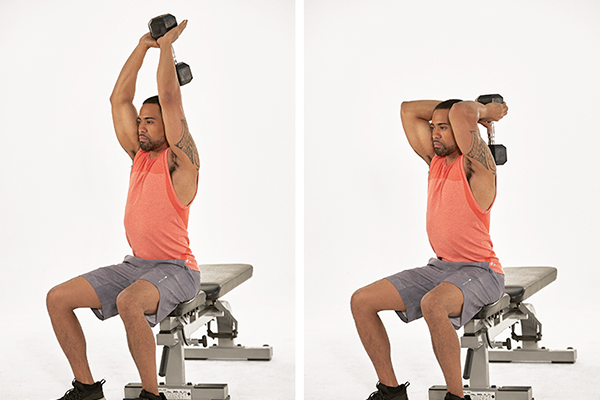
2 SUPERSET: BARBELL SKULL-CRUSHERS W/ ONE-ARM OVERHEAD DUMBBELL EXTENSION


FRI EXERCISE:

1 CLOSE-GRIP BENCH PRESS

2 SUPERSET: TRICEP PUSHDOWN W/ ONEARM OVERHEAD DUMBBELL EXTENSION

REP RANGES
WEEK 1: 30 Warm Up, 12, 10, 8, 6
WEEK 2: 30 Warm Up, 8, 6, 4, 2
WEEK 3: 30 Warm Up, 5, 5, 5, 5, 5
WEEK 4: Max out on ONE major exercise then 20, 15, 12, 10 on the others

Get Horseshoe Triceps With These 6 Simple Moves

Get Horseshoe Triceps With These 6 Simple Moves When your neighbor’s kid tells you to make a muscle, you’ll almost certainly flex your biceps — that flashy mountain of muscle on the inside of your upper arm. But if it’s impressive arm size you’re looking for, it’s the muscles on the back of your arm — the less-appreciated triceps — that should get most of your attention in your workouts. Here’s why: The triceps have nearly twice the muscle tissue of the biceps, so they have more potential for growth than their famous relatives on the opposing side of the upper arm. As that “tri” prefix suggests, the triceps consist of three segments, or heads. When defined and developed, these three muscles form a distinctive inverted “V” that runs from the back of your shoulder to your elbow along the back of your arm. Horseshoe triceps are one of those “tells” that make it clear that you put in the hours in the gym. They’re visible whenever you wear tank tops or short sleeves — one of those little beacons that declares, “Yup — I work out.” The triceps are active any time you straighten your elbow. “The incline press, flat bench press, and overhead press all work the triceps in almost exactly the same way,” says muscle-building expert Bret Contreras, PhD, CSCS, author of Strong Curves. So if you’re short on time, any chest or shoulder-based move where you press a weight away from you with your arms will also work your triceps to some degree. For maximal development, though, most people need direct triceps exercises. Here are a few of our favorites to build horseshoe triceps. 6 Moves to Help You Get Horseshoe Triceps For best development of those horseshoe muscles, choose a variety of exercises where the upper arm is in a different position relative to your trunk: overhead, behind you, and in front of you. 1. Dumbbell overhead triceps extension Hold a single dumbbell overhead with the handle vertical, palms on the inside edge of the top set of plates, thumbs and index fingers encircling the handle for safety. Keeping your elbows close to your ears, your face forward and your neck upright, bend your arms until you feel a deep stretch in your triceps. Pause for a moment and reverse the move, returning to the starting position. 2. Lying triceps extension (skullcrusher) Lie face up on a bench with your feet flat on the floor, and hold a pair of dumbbells above your chest with your arms straight and your palms facing each other. Without moving your upper arms, bend your elbows and lower the dumbbells to the sides of your head until your forearms dip below parallel to the floor. Pause, and then return to the starting position. 3. Triceps pushdown Stand facing a triceps machine with a rope attachment, and take hold of the ropes with a neutral (palms facing) grip. Lock your elbows into your sides, and keep them there throughout the movement. Slowly extend your arms, spreading your hands apart as far as possible at the bottom of the movement. Pause for a moment, contracting your triceps as hard as possible. Keeping your elbows by your sides, slowly bend your arms fully and return to the starting position. Repeat for reps. 4. Dumbbell triceps kickback Stand holding two light dumbbells by your sides. Keeping your lower back slightly arched, and your chest forward and up, bend your knees slightly and hinge forward at your hip joints until your trunk is nearly parallel to the floor. Bend your arms and lock your elbows to your sides (this is your starting position). Slowly straighten your arms, contracting the backs of your arms as hard as possible at the top of the move. Allow your upper arms to move upward — toward the ceiling — at the top of this exercise. Pause with your triceps fully engaged. Slowly reverse the move and return to the starting position. 5. Triceps dip Jump into the support position on a set of dipping bars: feet off the floor, shoulders down, elbows locked out, posture vertical. Slowly bend your arms and lower yourself until your upper arms are parallel to the floor. Pause for a moment, return to the starting position, and repeat for reps. 6. Banded triceps kickback Secure one end of a resistance tube with handles to a stationary object about six inches off the floor (the leg of a couch works well). Holding the free end of the band in your right hand, hinge forward at your hips until your torso is roughly parallel to the floor, and tuck your right elbow to your side. Step forward or backward so that there’s light tension in the band. This is your starting position. Keeping your right elbow pinned to your side, extend your right hand behind you. Squeeze your right triceps as hard as possible for a one-count, and then slowly return to the starting position. Perform equal reps with each arm. How to Start Tricking Out Your Tris Though they all work together to straighten your arm, the three heads of your triceps have distinct forms and functions: Long head The long head runs from the outside corner of your shoulder blade (near where your upper arm connects to your shoulder) down the back of your upper arm to your elbow, where it attaches near your funny bone. If you stand with your arms hanging down, the long head is the section of the muscle closest to your side. Because it attaches to your shoulder blade, the long head assists in the action of pushing your upper arm backward and behind you (picture pushing yourself forward with ski poles). Medial head The medial head runs from the back of your upper arm, close to your shoulder joint, down to your elbow. Parts of the medial head are obscured by the other two heads, but you can see and feel the sheet-like lower portion of the muscle just above the middle of your

Get Horseshoe Triceps With These 6 Simple Moves Read More »

Maximize Your Upper-Body Gains With a Push Day Workout

Maximize Your Upper-Body Gains With a Push Day Workout Adding structure to your fitness routine can make your workouts more purposeful and efficient, minimize the risk of injury, and yield even better results. One simple way to do this is a rotating daily schedule of push, pull, and leg workouts. What Is a Push Day? As the name suggests, a push day workout consists of upper body exercises that utilize a pushing motion. These exercises primarily target the chest, shoulders, and triceps. (Pull exercises, which engage the back, biceps, and forearms, are reserved for another day.) You can find push days in many weightlifting programs on BODi, such as LIIFT4 and Body Beast. They’re designed to work different muscle groups on different days so you can hit your workouts hard and optimize rest. While some people may choose to incorporate leg exercises on a push day, others dedicate a separate day to lower-body work. What Are the Benefits of Push Day Workouts? Pushing is a cornerstone of functional fitness. To simply get off the ground, you must be able to push up your body weight. “Performing a broad range of push exercises helps maintain a strong and healthy body,” says BODi Fitness Programming Manager Amanda Herrera. “Not just for your muscles, but your bones and joints as well.” Dedicating specific days to push day workouts allows you to work harder and maximize rest. “The idea behind separating push and pull days is to work specific related muscle groups together and to exhaust those muscles,” Lopez says. “Therefore, you won’t be training the same muscle groups two days in a row, which can help optimize recovery time.” 6 Push Day Exercises Chances are, you’re already doing push day exercises as part of your regular fitness routine. In case you need some ideas, here are a few push day workout staples. 1. Push-up Assume a high-plank position with your feet together, your body straight from head to heels, and your hands in line with (but slightly wider than) your shoulders. Engage both your glutes and your core to lock your body into position. Keeping your elbows tucked toward your body and your head neutral, lower your torso until your chest is within a few inches of the floor. Pause, and then push yourself back up to the starting position. 2. Shoulder press Stand tall with your feet hip-width apart and hold a pair of dumbbells in front of your shoulders with your elbows tucked in and palms facing each other. Keeping your core engaged and back flat, press the weights directly above your shoulders until your arms are straight and your biceps are next to your ears. Pause, then lower the weights back to the starting position. 3. Dumbbell bench press Lie on a sturdy, padded bench, feet flat on the floor, holding two heavy dumbbells at arm’s length over your chest, palms facing forward. Keeping your core engaged, lower back pressed into the bench, and upper arms at a 45 degree angle to your body, slowly lower the dumbbells until your upper arms are parallel to the floor. Pause, and then push the weights back to the starting position. 4. Dumbbell chest fly Lie on a flat bench or on a mat on the ground holding a pair of dumbbells at arm’s length above your chest, palms facing each other. Keeping your core engaged, lower back pressed into the bench or mat, and elbows slightly bent, slowly lower the dumbbells directly out to your sides until you feel a deep stretch in your chest. Pause, and then slowly reverse the move, returning to the starting position. 5. Dumbbell overhead triceps extension Sit on a bench or chair, cupping one end of a dumbbell in both hands directly overhead. This is the starting position. Keeping your chest up, core engaged, and back flat, lower the weight behind your head without moving your upper arms. Pause, and then press the weight back up to the starting position. 6. Dumbbell lateral raise Stand tall with your feet hip-width apart and your arms at your sides, holding a dumbbell in each hand. Raise your arms to your sides until they’re level with your shoulders. Keep your palms facing downward. Pause, and then lower the weights back to the starting position. How Should I Structure My Push Day? It’s generally a good idea to perform your heaviest lifts at the beginning of a workout, but the key is to stick to pushing exercises. As for the rest of your weekly workout schedule, some people find it helpful to have designated push and pull days and combine lower body and core work in one workout. So, for example, you could structure your routine as follows: Monday: Push day workout Tuesday: Pull day workout Wednesday: Legs and core workout Thursday: Push day workout Friday: Pull day workout Saturday: Legs and core workout Sunday: Rest “You don’t have to have a rest day in between push and pull days because they work different muscles, so you won’t be working the same muscles back to back,” explains Lopez. If you’re interested in a traditional push, pull, legs split routine, check out Body Beast on BODi. If you’re looking to balance cardio with heavy lifting, LIIFT4 combines HIIT and weight training to get you strong, lean, and fit. The post Maximize Your Upper-Body Gains With a Push Day Workout appeared first on BODi. Adding structure to your fitness routine can make your workouts more purposeful and efficient, minimize the risk of injury, and yield even better results. One simple way to do this is a rotating daily schedule of push, pull, and leg workouts. What Is a Push Day? As the name suggests, a push day workout consists of […] The post Maximize Your Upper-Body Gains With a Push Day Workout appeared first on BODi. William Kang{authorlink}https://www.beachbodyondemand.com/blog/push-day-workoutBODi BODi is a Health Esteem platform to help you embrace the person you are today so you can take action to achieve all your health and fitness goals. https://bodiblog.wpenginepowered.com/wp-content/plugins/bod-blog/assets/vendor/beachbodydigital/wordpress-core-plugins/beachbody.png

Maximize Your Upper-Body Gains With a Push Day Workout Read More »