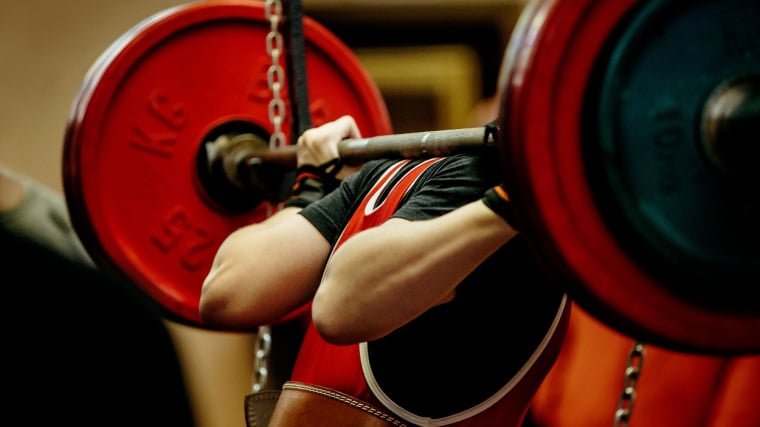
Powerlifting Records: How to Compare Your Lifts to the All-Time Greats Some people had a unique introduction to physical strength. At one point, they may have seen a person lift a heavy weight — whether it was a family member moving an “immovable” piece of furniture, a muscular athlete completing a “bench press challenge” on television, or a superhero hoisting a car overhead to save the day — and the spark was ignited. These feats of strength left an indelible impression and, sooner or later, they found their way into the gym and began developing their own muscular prowess. A few of the most straightforward avenues for lifters to test themselves is with “the big three” powerlifts — the squat, bench press, and deadlift. Credit: Real Sports Photos / Shutterstock Competitive powerlifting offers a chance for lifters of any age, size, or experience to compare themselves to modern day peers as well as legendary lifters of the past. Here’s a look at what it takes to complete remarkable powerlifting performances. Powerlifting Records What is Powerlifting? Powerlifting Divisions and Categories Current Powerlifting Records What is Powerlifting? To begin on page one, it’s important to understand what “powerlifting” actually is. While it might sound counterintuitive, powerlifting is distinctly different from weightlifting. The sport of weightlifting, as presented in the Summer Olympics, challenges athletes with the snatch and clean & jerk movements. Powerlifting tests athletes with the back squat, flat bench press, and deadlift (either conventional stance or sumo) to complete a “total” weight lifted for the contest. The sport of powerlifting formally began in 1964 with “The Powerlifting Tournament of America” being the first organized and recognized competition of the squat, bench press, and deadlift. Perhaps not coincidentally, the contest was held in York, Pennsylvania — home of US Olympic weightlifting coach and founder of York Barbell, Bob Hoffman. As powerlifting continued to grow, both across the United States and internationally. By the 1980s, it was considered a full-fledged, albeit niche, competitive sport. From the late 1970s until the early 2010s, it garnered enough widespread attention to warrant a dedicated print magazine, Powerlifting USA, which showcased sport-specific news and training features. View this post on Instagram A post shared by Mike J. Svilans (@magnoodles) As the sport of powerlifting grew in popularity, recreational lifters found a relatable outlet for testing their strength. While Olympic weightlifting is largely considered to rely on significant exercise technique, the big three powerlifts are relatively more simple to learn, making them more accessible to the average gym-goer. Powerlifting, in general, has nearly become synonymous with simply trying to build sheer strength in the gym. However, the sport itself has always revolved around three foundational exercises performed under specific criteria. If lifts are performed with different or “loose” technique, they’re ineligible for an official record. Squat In a powerlifting competition, the barbell back squat is the first of three movements tested. Depending on the specific federation and ruleset, the barbell is either supported on squat stands or in a monolift — a hydraulic-assisted machine which allows lifters to set up in a squat stance without repositioning their feet. Powerlifting squats are universally tested by requiring lifters to descend until their hip joint is parallel to their knee joint. This is where the common cue “squat to parallel” comes from. Contrary to some common opinions, “parallel” is not necessarily related to the lifter’s thigh position because heavily muscled legs may not appear to reach parallel when the hip is at a suitable depth. Lifters may use either a low bar or high bar setup, depending on their individual preference. The key performance factor is reaching the target depth, and the lifter’s body type and mobility will dictate their most efficient technique. Bench Press The flat barbell bench press is the sole test of pure upper body strength in a powerlifting competition. The majority of powerlifting federations have grip standards, often maintaining a grip that has at least one finger in contact with the pre-set ring markers on the barbell. Lifters must keep their head, shoulders, and glutes in contact with the bench throughout the entire press, while also keeping their feet touching the floor. The barbell is lowered to chest-level and must remain in contact with the athlete’s body until a judge gives the “press” command to begin the ascent. This ensures a consistent depth marker for each lifter while helping to prevent momentum from bouncing the bar off of the chest. The bar is then held in the locked out position until the lifter receives a judge’s command to “rack.” View this post on Instagram A post shared by IPF Powerlifting (@theipf) Controversially, lifters may initially set up with an arch in their lower back which may add pressing stability and reduce their range of motion, making the lift less challenging. However, some federations, such as the International Powerlifting Federation (IPF), have taken steps to limit the degree of arch lifters may use. Deadlift “The meet doesn’t start until the bar hits the floor,” is a common phrase heard in powerlifting circles to emphasize the importance of the contest’s final movement — the deadlift. With the bar beginning on the floor, lifters must complete a deadlift in one smooth motion. Jerking or “hitching” the bar up the thighs disqualifies the lift. Full lockout is achieved when the lifter’s legs are straight and their shoulders are behind the bar. In competition, powerlifters are not allowed to use lifting straps, but can grab the bar with a double-overhand, mixed (over/underhand), or hook grip (grabbing the thumbs along the underside of the bar). Internet meme culture seems to enjoy claiming that “sumo deadlifts don’t count,” but no actual powerlifting organization has fallen in line with that approach. Lifters are free to choose their own deadlift stance — conventional, sumo, or somewhere in between — according to their individual leverages and optimal power output. Total The powerlifter’s total is the sum of their best performance in each of the three lifts.