Business & Career Resources

Auto Added by WPeMatico

Uncover the Best in Health: Our Top Nutrition Podcast Picks 

Uncover the Best in Health: Our Top Nutrition Podcast Picks  Podcasts have become a valuable source of information and entertainment for people all over the world. They fit perfectly into our busy lives, allowing us to listen while doing other things like commuting, working out, or cooking. When it comes to health and wellness topics, podcasts are an entertaining way to stay up-to-date with research and trends.  As a nutrition coach and specialist, I listen to a lot of podcasts. I find that not only are podcasts convenient, since I can listen to them in the car or as I meal prep, but they are super entertaining. Over time, I grow to feel fond of the podcasters and appreciate what they bring to the table – literally and figuratively. I also find that particular episodes can be very helpful as a resource for clients. For example, when I found a podcast episode about tricks to establish new eating habits, I shared that with a client with whom I’d discussed the importance of creating habits to reach goals.   In this article, I’ll be sharing my own—along with AFPA’s—top nutrition-related podcasts that cover a wide range of topics related to food, diet, and overall wellness. Whether you’re a nutritionist looking to stay up-to-date with nutrition information and trends, or if you are someone who wants practical advice, we’ve tried to pick something for everyone.  How did we go about choosing these podcasts? We considered the following details:  Expert Insights: The podcasts allow you to gain access to valuable information shared by professionals who specialize in nutrition and wellness.  Practical Tips: You’ll learn actionable strategies that you can easily implement in your daily life or your business.  Inspiration: You’ll hear success stories from individuals who have transformed their wellness and nutrition through behavior change, nutrition science, eating habits, their relationship with food, and more.  Latest Research: The podcasts include the latest scientific findings and trends in the world of nutrition.  Note: Some podcasts are mentioned more than once throughout the article because they fit into multiple categories.  Best Overall Nutrition Podcasts  We chose the best overall nutrition podcasts after thorough consideration of several factors. Key selection criteria included:  Host Expertise: The host’s background, education, and experience in the field of nutrition.  Credibility: The use of evidence-based information and reputable guest experts.  Listener Reviews: Positive feedback and high ratings from the podcast audience.  Below are the top contenders in this category:  1. ZOE Science and Nutrition  ZOE CEO Jonathan Wolf hosts a show where leading scientists present accessible explanations of the latest health, nutrition, and gut health research to aid in weight and health improvement. Jonathan interviews experts in their field, starting out with short key questions that entice you to continue listening. The topics range from gut health to nutrition behavior and epigenetics. While the topics may seem complex, the conversational format makes it easy to understand and entertaining.   2. Nutrition Nerd  No matter your background, sometimes nutrition terms can seem complex. This podcast is a great way to keep up with trends and is a great resource for clients and nutritionists alike. The episodes are short and sweet, allowing you to feel more prepared and educated after only a few minutes. The host, Delancey Prince, offers bite-sized episodes teeming with the latest nutrition terms and concepts. This podcast stands out for its ability to distill complex topics into manageable insights accessible to all.  3. The Proof with Simon Hill  Simon Hill expertly navigates discussions on the longevity benefits of exercise, nutrition, mindfulness. This podcast takes a holistic but science-backed approach to wellness and nutrition. His approach is rooted in scientific research, making it an invaluable resource for those looking to deepen their understanding of plant-based nutrition and holistic health.  4. Sound Bites: A Nutrition Podcast  Registered Dietitian Nutritionist Melissa Joy Dobbins hosts this podcast which showcases credible food and nutrition information based on facts. By featuring interviews with leading experts, listeners are treated to a range of topics from diet myths to nutritional breakthroughs.   —  Each podcast offers unique perspectives and invaluable content for anyone looking to improve their nutritional knowledge. Aspiring holistic nutritionists might find additional insights by exploring our blog on the Top 13 Podcasts for Holistic Health and Nutrition Coaches.   Get Your Free Guide to Becoming a Holistic Nutritionist Learn about the important role of holistic nutritionists, what it takes to be successful as one, and how to build a lucrative, impactful career in nutrition. Best Plant-Based Nutrition Podcasts  When it comes to finding the best plant-based nutrition podcasts, two key factors came into play: the podcasters have a strong commitment to plant-based principles, and they deliver the informative content in an engaging and practical way. These podcasts dive deep into the world of plant-based diets and lifestyles, offering valuable insights on adopting and maintaining a vegan diet while embracing a plant-based lifestyle.  1. The Proof with Simon Hill  One standout podcast in this realm is The Proof with Simon Hill. This podcast takes a comprehensive approach to discussing the health and longevity benefits associated with plant-based diets, inspired by his book The Proof is In the Plants. Listeners can gain valuable knowledge on plant-based nutrition and on integrating it with exercise and mindfulness to optimize their well-being.  2. Food Heaven Made Easy  Another notable plant-based eating podcast is Food Heaven Made Easy, hosted by registered dietitians Wendy Lopez and Jessica Jones. What sets this podcast apart is its unique perspective on plant-based eating, which is rooted in principles like Health at Every Size® (HAES) and intuitive eating. Listeners can expect actionable advice on incorporating plant-based meals into their daily lives while promoting mental health and wellness.  —  By the way, if you’re interested in advancing your knowledge in nutrition, you may find value in exploring nutrition certification programs offered by AFPA Fitness. They provide answers to frequently asked questions about their nutrition certification programs, helping you make an informed decision about your educational path.  Both

Uncover the Best in Health: Our Top Nutrition Podcast Picks  Read More »
Wellness Reimagined: Top Health and Wellness Trends for 2024 

Wellness Reimagined: Top Health and Wellness Trends for 2024  Navigating the Evolving Landscape of Health and Wellness in 2024  Welcome to our exploration of the health and wellness landscape as it unfolds in 2024. The realm of health and wellness is in a constant state of evolution, shaped by emerging research, technological advancements, and shifting societal values. As we delve into this dynamic world, it’s crucial for certified personal trainers, health and wellness coaches, and nutrition coaches to understand that staying abreast of these trends is not merely about keeping pace with what’s popular. Rather, it’s about recognizing how these trends reflect the latest research and embody best practices in health and wellness.  In this article, we aim to provide a comprehensive overview of the most promising and impactful trends in health and wellness for 2024. Our focus is not on fleeting fads but on trends with the potential for sustainable, long-term benefits. These trends have been carefully selected for their alignment with current research and their capacity to positively influence health and wellness practices.  From the integration of technology in personal health management to the growing emphasis on mental well-being and community-driven wellness, each trend we explore is a piece of the larger puzzle of holistic health. We believe that understanding these trends is essential for anyone looking to enhance their well-being or guide others in their health journeys. By embracing these trends, we can make informed choices that benefit us today and pave the way for a healthier future.  Join us as we navigate the exciting and ever-changing landscape of health and wellness in 2024, where innovation meets tradition, and where each step forward is guided by the latest in scientific research and best practices.  Learn How to Set Yourself Apart as a Board-Certified Health Coach Hobby-Based Movement: Enhancing Health Through Enjoyable Activities  Hobby-based physical activities encompass a range of enjoyable and engaging pursuits that contribute to physical fitness and overall health. These activities are often pursued for pleasure and relaxation, rather than solely for exercise or competition. The rise in popularity of such activities can be attributed to a growing awareness of their holistic health benefits and a shift toward more enjoyable forms of physical activity.  Examples of Hobby-Based Movement  Dance: Dance, as both a sport and a hobby, has gained popularity in recent years. It offers a therapeutic factor, providing an outlet for emotions and contributing to general well-being. A study titled “Dancing Through the Pain: Dance as a Psychotherapeutic Outlet” highlights that 80% of participants used dance for mental health benefits, and 65% used it as an outlet for emotions.  Hiking: Hiking in parks and recreation areas has been linked to higher levels of physical activity. A study examining individuals who engage in physical activity in parks found a significant correlation between the frequency of visits to these areas and higher physical activity levels, suggesting that hiking can effectively contribute to physical fitness.  Gardening: Gardening is recognized as an everyday activity that contributes to physical health. It is a form of active recreation that can reduce the risk of developing heart disease, stroke, high blood pressure, and some cancers, while also helping in weight control and stress management.  Benefits of Hobby-Based Movement for Physical and Mental Health  Hobby-based physical activities like dance, hiking, and gardening offer numerous health benefits. They not only help in maintaining physical fitness but also play a crucial role in mental health. Engaging in these activities can alleviate symptoms of depression and improve the quality of life. For instance, the “Exercise Intervention” paper discusses how exercise and physical activity, including hobby-based activities, can be a low-cost alternative to traditional treatments for depression, enhancing positive emotions and overall well-being.  In summary, hobby-based physical activities such as dance, hiking, and gardening are not only enjoyable but also significantly contribute to both physical and mental health. Their rising popularity underscores a broader understanding of health and wellness, emphasizing the importance of engaging in activities that are both beneficial and enjoyable.  Meditation Apps: Harnessing Technology for Mindfulness and Stress Reduction  The proliferation of meditation and mindfulness apps reflects a growing societal interest in accessible, technology-based solutions for enhancing mental wellness. These apps have become popular self-help tools, offering a convenient way for individuals to engage in mindfulness practices, which have been traditionally associated with stress reduction and improved mental health.  How Technology Can Aid in Stress Reduction and Mental Wellness  Meditation apps have shown promising results in decreasing stress levels among users. A study titled “Do Mindfulness Meditation Apps Decrease Stress in College Students?” found that consistent use of mindfulness meditation apps significantly reduced self-reported stress levels in college students. This suggests that regular engagement with these apps can be an effective tool for managing stress.  Another study, “Managing Emotions: The Effects of Online Mindfulness Meditation on Mental Health and Economic Behavior”, demonstrated that access to a mindfulness meditation app led to a substantial reduction in symptoms of stress, anxiety, and depression. This indicates the potential of these apps to positively impact mental health and even influence economic decisions by improving focus and productivity.  Popular Mindfulness Apps and Their Unique Features  Headspace: Known for its user-friendly interface and diverse range of guided meditations, Headspace caters to both beginners and experienced practitioners. It offers sessions on stress management, sleep, and focus.  Calm: Calm stands out for its variety of mindfulness exercises, sleep stories, and breathing techniques. It’s particularly noted for its effectiveness in improving sleep quality and reducing anxiety.  Insight Timer: This app offers a vast library of free meditations and is favored for its community features, allowing users to connect with others and share experiences.  10% Happier: Targeted at skeptics, this app combines practical meditation techniques with a no-nonsense approach, focusing on tangible benefits and personal improvement.  In summary, meditation and mindfulness apps are a growing trend in the health and wellness sector, offering accessible and effective tools for stress reduction and mental wellness. Their unique features cater to a wide range of preferences,

Wellness Reimagined: Top Health and Wellness Trends for 2024  Read More »

5 Ways to Diversify Your Income as a Personal Trainer

5 Ways to Diversify Your Income as a Personal Trainer Personal trainer certification completed—check!  Motivation to put your certification to work—check!  Innovative ideas for how to make an income as a personal trainer—pending. You’ve done the hard work to get your certification, and now you’re ready to get to work and start making some money doing what you love.  The first step to starting your personal trainer business is finding your niche. By narrowing your focus, you will be able to design your service offerings to meet your client’s specific needs.  Next, it’s time to get innovative. What are some ways that you can make money as a personal trainer to set you apart from the crowd? Below we describe five ways you can make money as a certified personal trainer. If you want more information on what your earning potential is as a personal trainer, check out the Ultimate Personal Trainer Salary Guide.  Learn How to Become a Certified Personal Trainer Online in Less Than 6 Months 5 Ways to Diversify Your Income as a Personal Trainer Exclusive One-on-One Training Most people imagine personal trainers engaging in one-on-one training, and there is a significant need for trainers who provide this service. You can offer your services as an employee of a gym or as a freelance personal trainer who can visit people’s homes.  From the perspective of business income, however, when a personal trainer depends solely on one-on-one training as their main income source, their potential to grow their business is limited by the number of hours they have in a day to be with clients. When trying to maximize your income with this model, you’re more at risk of personal trainer burnout. So, how can one-on-one training be best utilized to increase your income? You can offer this service as an “exclusive” service in addition to group training or other income streams. When you brand your one-on-one training sessions as exclusive, limited, and high-value, people will be willing to pay significantly more, especially if they have already taken advantage of your other services and have been satisfied.  Group Training Group training is a great model to train several people at once in an in-person class format or online as part of a training program.  Clients often seek out this option because they enjoy the opportunity to socialize with other people to create a supportive community and pay less than for one-on-one sessions.  For personal trainers, group training sessions are a great income generator when you enroll many clients at once, but you should establish a minimum enrollment goal to make sure you cover costs and pay yourself. Keep in mind that, even for group training, you need to make an effort to make a personal connection with everyone in the class. While it may be tempting to take as many people as are interested to maximize your income, you should put a cap on the number of people that can enroll based on your ability to give each person the attention they need to carry out the training responsibly and carefully. Remember, you can always open up another session!  Group training can be carried out in person or on online platforms, including a personalized branded app, Facebook groups, or apps designed for personal trainers.  Online Training You can use digital tools like apps and meeting platforms (Zoom, Skype, Google Meet) to offer classes to a large group of clients. You can also prerecord classes that people can playback with a fee.   If you choose to offer your services on an app, you have two main options. You can create your own personal training app by hiring an app designer, or you can upload your routines onto an app designed specifically for personal trainers to interact with their clients.  The advantage of using online training platforms is that there is plenty of room for income growth. They are also becoming more and more popular for clients to use, as home workouts become the norm and app access tends to cost less than  gym memberships.  Remember that to get people to sign up for online training, you’ll need to get them onto your site or your app to make a purchase. Here are some ideas for how to turn your social media followers into client leads.  Digital Products It’s time to own it—the most valuable part of your personal training certification lies in the knowledge you bring to the table. When you find the sweet spot between your coaching knowledge and understanding your niche’s needs, you have information and tools that your target audience will be happy to pay for.  Invest time and resources to put your know-how into e-books that describe your unique methodology or that share unique tools and tips. You can also build downloadable workout plans that will help your clients achieve a certain goal.  To make the most out of selling digital products, it’s important to have a website you can be proud of and implement an effective social media strategy to turn your social media followers into leads.  If you’re interested in learning how to turn your social media followers into paying clients, read this article.   Membership Programs When it comes to leveraging your income, membership models are extremely effective ways to secure your income. The membership model can be integrated with many of the income sources mentioned above, including online and in-person one-on-one and group training, digital product offerings, and app subscriptions.  The difference between a membership model and session-based model is that a membership model helps to secure income from your clients on a monthly basis. When you charge by individual sessions, clients can easily become irregular or they can choose not to pay for a personal training session from one week to another. This makes it difficult to have a steady income and make the most of your time.  Membership models are usually based on a set monthly fee for which paying clients gain access to different services and digital products.

5 Ways to Diversify Your Income as a Personal Trainer Read More »

5 Tips for Passing Your Personal Trainer Certification Exam

5 Tips for Passing Your Personal Trainer Certification Exam When you have a passion for health and fitness, there’s a good chance you’re the go-to person your social network reaches out to for advice and information about cardio workouts, strength training, healthy eating, injury prevention, and race-prep strategies. Sound familiar? For a lot of fitness-minded people that’s the route to becoming a personal trainer. You find yourself fielding a lot of questions, helping people train smarter, and diving into the research to keep learning more. Reach this point in your journey, and becoming a certified personal trainer is a natural next step. But you’ll need to pass your personal trainer certification exam first. And instead of the old-school sink-or-swim style of taking tests in school, American Fitness Professionals & Associates gives you all the tools you need to pass your exam. Work your way through the training materials and follow these tips for passing your personal trainer certification exam, and you’ll be able to turn your passion for health and fitness into profits. Here’s what to do to get ready for the exam: Learn How to Become a Certified Personal Trainer Online in Less Than 6 Months 1. Visualize passing the exam If you’re thinking about skipping over this, don’t. It might seem like a silly intellectual exercise, but it works. Take a few minutes to simply visualize your exam day. You wake up well rested. You’re happy, confident, and knowledgeable after studying and learning all the materials. You feel relaxed, even when it’s time to take the test. Imaging yourself recalling all the information you’ve studied with ease as you move through the question set. And visualize the feeling of satisfaction of passing the personal trainer certification exam. It’s an exercise that one of the legends in the fitness industry has used  for decades to win bodybuilding competitions, dominate the silver screen with a stunning physique, and inspire others to make smart lifestyle decisions about fitness and nutrition. “The mind is the limit,” says Arnold Schwarzenegger. “As long as the mind can envision the fact that you can do something, you can do it, as long as you really believe 100 percent.” 2. Create a study plan that fits your life When you receive the study materials for the personal trainer exam, you’ll realize there’s lot of information to cover. If you’ve already been immersed in health and fitness, you’ll be one step closer to passing the exam. But you’ll still need to study. Work out a study schedule that fits your life, work, family, and other commitments. Maybe you’ve got the bandwidth to study two hours a day. Maybe your best study time is a couple of hours on the weekend. Or maybe your schedule is totally open and you can dedicate a bigger chunk of time to study every day. Figure out a study plan that fits your life, and stick to it. It’s an investment in yourself, and those little chunks of study time will help you pass the personal trainer exam. 3. Don’t try to memorize everything The materials you receive to study for the exam make up a comprehensive resource library of everything you need to know about the business of being a personal trainer, anatomy and physiology, training strategies, client interactions, nutrition guidelines, and much more. You should read and study everything. But don’t obsess over memorizing every detail. Obviously there are key principles and facts you need to understand to pass the personal trainer certification exam. But you’ll also have these materials to refer back to when you do start training clients to create safe and effective training plans. Instead of just memorizing the facts, study the material and think about how it applies to training people. 4. Study, practice, repeat You have six months to study for the personal trainer certification exam from the time of enrollment. That’s about 180 days, 4,320 hours, and 259,200 minutes. And if you make “study, practice, repeat” your mantra, and take the full six months to get ready, you’ll be able to cover a lot of material in that amount of time. Take the practice quizzes. Read and study the course textbooks. Use the DVD set. Make your own flashcards you can use to study on the go. And take advantage of the unlimited student support to get help, answer questions, and prep for the exam. Study, practice, repeat…study, practice repeat. 5. Believe in yourself Meet with personal training clients long enough, and you’ll start to realize that a lot of people know what they should do to lose weight, build muscle, or improve their health, but they’re just not doing it. Why? A lot of times, it’s because fear or self-doubt gets in the way. As a trainer, you can literally transform people’s lives by giving them a boost of confidence and pointing the way to help them achieve their goals. To be a motivating force for others, you also need to have confidence. As part of your journey to pass the personal trainer certification exam, you need to believe in yourself. Every time you sit down to study, think about taking the exam, field a question from a friend about health and fitness, or see something that reminds you of your goal to become a personal trainer, train your brain to repeat this: “I want to inspire people. I want someone to look at me and say, “Because of you, I didn’t give up.” Put in the work, study, train your brain to think like you’re already a pro, believe in yourself, and you’ll be ready to pass the exam. You got this. The post 5 Tips for Passing Your Personal Trainer Certification Exam appeared first on AFPA. When you have a passion for health and fitness, there’s a good chance you’re the go-to person your social network reaches out to for advice and information about cardio workouts, strength training, healthy eating, injury prevention, and race-prep strategies. Sound familiar? For a lot of fitness-minded

5 Tips for Passing Your Personal Trainer Certification Exam Read More »

5 Ways to Take Advantage of the $3.4 Trillion Health and Wellness Industry

5 Ways to Take Advantage of the $3.4 Trillion Health and Wellness Industry Demand for health and wellness is higher than ever, and growing fast. The Global Wellness Institute, a research firm that focuses on areas like healthy eating, fitness, and anti-aging efforts, notes that wellness is a $3.4 trillion market. That makes it nearly three times larger than the $1 trillion worldwide pharmaceutical industry. According to research firm Technavio, we can expect steady growth of at least 6 percent from 2016  through 2020. Another research organization, Nielsen, notes in a recent report that “most consumers are more interested in staying out of the doctor’s office than they are about scheduling their next physical.” That’s leading many people to take charge of their nutrition and fitness goals in meaningful, long-term ways. Become a Certified Holistic Nutritionist Online in 6 Months or Less That opens up huge opportunities for those who specialize in health and wellness. From personal trainers to nutrition experts, professionals in the wellness field can expect steady client growth, especially if they keep expanding their services. How can you take advantage of the boom? Here are five possibilities to consider. 1. Get a certification What are you most passionate about? Taking the time to truly think about that question can lead you to explore options for a certification program. For example, you might want to become a group fitness instructor if you’ve found yourself going to classes and brainstorming ways you’d put your own class together. Or if you seem to be the go-to friend for nutrition advice, you can turn your enthusiasm for healthy eating into an actual career. Whatever you choose, a certification from an accredited organization gives you the extensive knowledge you need to excel in the field, and also assures your clients that you’ve received superior training. Another advantage to certification is that you can get your education much faster and more affordably than you’d find with a four-year college degree. Plus, in a certification program, you’ll be learning only about your new field, rather than studying the kind of non-relevant “foundation” courses that many colleges require. 2. Make a career change With a certification, you can consider taking the step toward a new career in the health and wellness industry. Make a solid plan that includes narrowing down your choices, picking a specialty, determining your strengths, and understanding your resources. Once you see how many opportunities there are in the health and wellness industry, you’ll be excited and energized for your fresh new career. 3. Start a side job If you’re not ready to leave your current career for health and wellness, consider making your role as a trainer or nutrition professional into a side business that you could do on evenings and weekends. Some in health and wellness “meet” with clients over video chat, which means that not only can you see clients from anywhere, but you can also set your own schedule when it comes to fitting this new side job into your life. 4. Team up with other health professionals If you’re a personal trainer, you could connect with nutrition professionals to offer more for your clients—and that contact would, in turn, send his or her clients your way as well. The more often you can team up, the more you can expand your services, which will be very attractive to clients who are looking for advice on fitness, training performance, nutrition, and other health strategies. 5. Expand your knowledge With certifications, you can get an initial education in a field, and then move on to more advanced training that will help you deepen your knowledge or expand what you offer. For instance, you could earn a personal trainer certification and then go after a weight loss specialist certification if you find that many of your clients are struggling with weight issues. You can also specialize in certain populations, like youth or seniors. The more certifications you earn, the greater your knowledge base will be, and the more opportunities you might find. To learn more about AFPA’s certification programs, visit our programs site. We also created the Career Change Guide to give you more insights. The post 5 Ways to Take Advantage of the $3.4 Trillion Health and Wellness Industry appeared first on AFPA. Demand for health and wellness is higher than ever, and growing fast. The Global Wellness Institute, a research firm that focuses on areas like healthy eating, fitness, and anti-aging efforts, notes that wellness is a $3.4 trillion market. That makes it nearly three times larger than the $1 trillion worldwide pharmaceutical industry. According to research […] The post 5 Ways to Take Advantage of the $3.4 Trillion Health and Wellness Industry appeared first on AFPA. Maddy{authorlink}https://www.afpafitness.com/blog/3-4-trillion-dollar-health-and-wellness-industry/Blog – AFPA TURN YOUR DREAM CAREER INTO REALITY https://www.afpafitness.com/wp-content/uploads/2022/07/fav.webp

5 Ways to Take Advantage of the $3.4 Trillion Health and Wellness Industry Read More »

How Much Can I Make as a Holistic Health Coach? 7 Factors to Consider

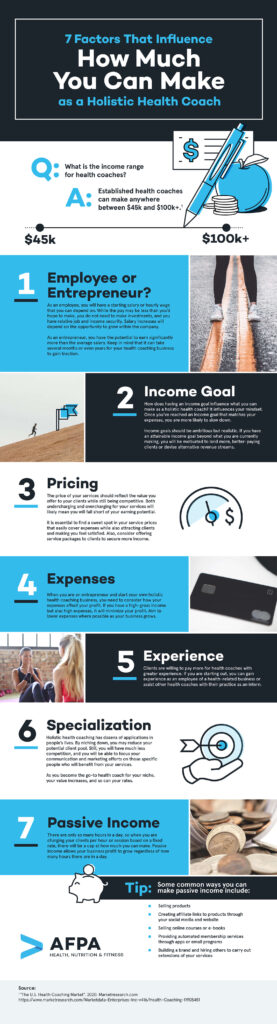
How Much Can I Make as a Holistic Health Coach? 7 Factors to Consider One thing that holistic health coaches have in common is that they are passionate about helping others live healthier, more fulfilling lives through lifestyle choices and mindsets that support their clients’ minds, bodies, and spirits.  However, no matter how passionate you are about coaching, everyone needs to make a living. Whether you are considering a career in holistic health coaching, are currently studying to obtain your certificate, or you are recently certified, it is only natural for you to ask yourself: “How much can I make as a holistic health coach?” The field of health coaching has multiple applications, so your income can vary greatly. What factors influence your income prospects, and what can you do to aim higher? Here are seven factors to consider.  Learn How to Become a Certified Holistic Health Coach Online Employee or Entrepreneur Whether you choose to work for an organization or start your own business could influence how much you make as a holistic health coach.  This is not to say that working as an employee will mean that you make less than an entrepreneur or vice versa, but it can influence your income prospects as you start out and as you grow.  Hospitals, clinics, and healthcare organizations are becoming more and more aware of the critical role health coaches can have to improve patient outcomes, so positions are open to health coaches of different backgrounds, specializations, and experience levels. As an employee, you will have a starting salary or hourly wage that you can depend on. According to some limited data, as an employee, general health coaches make an average of $43,500 a year but can earn upwards of $100,000 a year and beyond. However, keep in mind that as an employee, you do not need to make investments in equipment or pay rent, as the hiring organization is responsible for doing that. Any increases in your income depend on the possibility for you to get promoted within the company.  What is a realistic salary? Check out AFPA’s Professional Salary Guide for more information.  When you go the entrepreneurial route, you are not limited by a salary assigned to your job role. If you offer high-value services, implement an effective marketing strategy, have a plan for steady business growth, have a targeted niche, and minimize expenses, you have the potential to earn significantly more than the average salary. However, it can take several months or even years for your health coaching business to gain traction, as is true for many entrepreneurs.  Some health coaches who are starting out decide to take on a salaried or hourly waged position while building their entrepreneurial ventures to make a living wage while their own business gains traction.    Income Goal Believe it or not, your income goals significantly influence what you will end up making.  Keep in mind that your living wage is not the same thing as your desired income.  Your living wage is what you need, at a minimum, to cover your current expenses, including food, rent, mortgage, entertainment, and bills.  Your income goal is what you aim to make so you can have extra cash to invest in yourself and your business, build other companies, support causes you care about, set aside money for retirement or your kid’s education, and generally live a more comfortable life.  How does having an income goal influence what you can make as a holistic health coach? It influences your mindset. Once you’ve reached an income goal, you are more likely to slow down. Income goals should be ambitious but realistic. If you have an attainable income goal beyond what you are currently making, you get the creative juices flowing to find ways to get more, better-paying clients or devise alternative revenue streams. Your income goal should keep the following in mind:  Service and product pricing Realistic workload Keeping track of expenses Creating an emergency fund Saving for taxes Pricing What you charge for your services is a critical factor that influences how much you can make. This doesn’t mean that those who charge more will make more income; there are multiple other factors at play. First is whether your potential clients feel that your rates match the value you provide. This depends on how your rates stand against the competition.  Keep in mind that overcharging is an issue just as much as undercharging for your health coaching services. If potential clients feel that you are overcharging for your services, you may get lucky and land two or three clients, but there is also a chance you may not get any clients if other health coaches offer the same that you do for less. It’ll also be more likely that clients will ask for a discount. If you are undercharging your services with the hopes of gaining clients, two issues could arise. First, you could garner more clients than you can handle and still fall short of your ideal income. Second, clients may feel that your fee might be a reflection of the quality of your services and turn you away for that reason.  On the other hand, if clients feel that you offer competitive rates for the value that you provide, you may find yourself booking clients months in advance and securing an income in the medium and long term.  In short, as you decide on the pricing of the services you provide, you’ll need to consider what the market of health coaching services looks like in your niche and geographic location. You should also determine your specific services’ value and make sure that your rates and prices will turn a profit after covering expenses.  One strategy you can consider is offering package rates versus hourly rates. If you charge by the hour, you run the risk of a client coming to you irregularly. If you offer package rates for a certain number of hours or sessions, you can secure a certain income

How Much Can I Make as a Holistic Health Coach? 7 Factors to Consider Read More »

How to Build Your Network as A Nutrition Professional

How to Build Your Network as A Nutrition Professional Starting your own business as a nutritional professional is exciting. You get to set your own hours and help your clients make lasting positive changes in their health. You are also doing it solo, which can make drumming up business and networking a bit intimidating.  Whether you’re an introvert that feels challenged by putting yourself out there, or you get excited at the idea of meeting new people but just need more inspiration on how to maximize your effectiveness, this article is for you. We’ve got you covered with 10 networking tips to help nutrition professionals navigate networking opportunities without a colleague by your side. Have an Idea of What You Want Being open to what may come from a connection does not mean you cannot have ideas. Are you looking for individual clients? Hoping to fill a specific cohort of clients? Want to meet fellow business owners for support? You can network for different purposes or be open to them all. Knowing what you want ahead of time will help you create connections and know what to chat about with people.  Practice Introducing Yourself Whip out your phone or fire up your computer’s movie-making software. Record yourself introducing yourself and stating your elevator pitch for your business and then watch it. While it might be painful at first, the best way to recognize your habits, from a lot of “umms” to gestures, is to record, watch, and record again until you feel confident.  Be sure to include what you do, who you work with, and where you are located or how you work. Keep this info short so it is easy for people to process. But don’t be so short that they don’t know how to continue the conversation. Find a Mentor Another excellent way to build your network and learn is to get a mentor who has an already established business. Your mentor does not have to be a nutrition professional either. In fact, it might be helpful if this person is in a complementary business, related industry, or works the same way. For example, massage therapists, private practice psychologists and psychotherapists, personal trainers, and yoga teachers are all in health and wellness. They will understand your industry. But anyone with a successful small business offering services will too, such as a writing or business coach. Even the owner of a local coffee shop might make a great mentor.  A good mentor is someone who you can relate to, is comfortably willing to spend time offering advice, and can offer some business wisdom. A great mentor will also be your champion and can help you grow your network. That coffee shop owner might be open to you hosting your own weekly networking event! Attend Networking Events This one might sound obvious, but that’s because there are events specifically designed for networking, and then there are also other networking opportunities, such as securing a table at a local health fair. Do a quick search online for networking events in your area, and you are bound to find some great options, especially if you live in a metro area. A lot of businesses host free and open networking events as part of their community relations. A great place to look is with your local chamber of commerce too. After all, they want their community’s businesses to thrive. These events do not have to be specific to your industry either. Building connections, spreading the word that you are open for business, and getting yourself out there and meeting people is a great way to garner support for your work and expand your network. It’s also a great confidence booster and reminds you of who you are, what you do, and why you are great.  Arrive at the Right Time Walking alone into a networking event that is already roaring along is intimidating and harder to break into. Show up right on time when the room is usually quieter and other solo-networkers are arriving too. Instead of posting up against a wall, sitting at a table, or diving into food immediately, grab a water and stay close to the entrance so you can be visibly open to conversation and also see people as they walk in.  Talk, But Not Too Much Remember that everyone came to network. They want you to talk to them, especially that wallflower in the back. Don’t sit or stand around waiting for someone to come to you. You’ve rehearsed your intro, so break out a warm smile and say hi. Try chatting in the food line or greeting someone who just walked in. Also, know when to move along from a conversation. At a networking event, it is perfectly okay to say hi, chat a little, and move along to another person. Some people will get a follow up from you, and others will not. Do not feel obliged to stick around longer than you need to.   Be Easy to Follow Up With Business cards are great, but business cards with QR codes and digital business cards are even better. How many times have you collected a bunch of business cards only to leave them sitting around your desk? Or worse, lose them in your car or carrying case? Save yourself in your phone contacts and text or directly share your info with people immediately, especially if you are highly interested in following up and staying connected. You can also be savvy with the “notes” field in your own contact info. Include the name of the networking event, your website, and social media handles, and say thank you for the connection.  Whether you receive a business card from someone else or add them to your contacts, include a little note to yourself about how you met them and what you talked about. That way, you don’t have to worry about remembering all the details and you can move right along to more networking.  Go Digital When you

How to Build Your Network as A Nutrition Professional Read More »

5 Places That Are Hiring Health Coaches

5 Places That Are Hiring Health Coaches In the ever-evolving landscape of health and wellness, the role of holistic health coaches stands out as both unique and indispensable. With an approach that marries scientific knowledge with the art of human connection, these professionals guide, support, and empower individuals on their journey to optimal health. As the health paradigm shifts from treating illnesses to promoting wellness, holistic health coaching has taken center stage. The rise of this profession offers not just an opportunity for individuals to transform their health but also for aspiring health and wellness coaches to carve out a rewarding career in a multitude of settings. This article delves into the avenues available to holistic health coaches, showcasing the breadth and depth of opportunities awaiting them.  Holistic Health Coaching Trends  The complexities of the modern world, replete with technological advancements and evolving lifestyles, have underscored the need for holistic wellbeing. As a result, holistic health coaching has emerged as an integral component in the pursuit of overall health.  Understanding the Rising Trend in Holistic Health Coaching  Holistic health coaching’s growing prominence can be attributed to several factors:  Overwhelming Information: In the age of the internet, the sheer volume of health and wellness data can be daunting. Coaches serve as navigational beacons, guiding individuals through dense forests of information.  Mind-Body-Spirit Connection: Contemporary health perspectives advocate for an integrative approach, emphasizing the unity of emotional, spiritual, and physical health.  Shift from Curative to Preventive: With the rising costs and often reactive nature of modern healthcare, preventive approaches, as championed by holistic health coaches, are in higher demand.  Desire for Authenticity: Amidst the proliferation of commercialized wellness trends, there is a marked trend toward genuine, personalized health strategies.  Holistic Health Coaching: A Beacon for Overall Wellbeing  The overarching benefits of holistic health coaching encompass:  Comprehensive View: Holistic health coaching encapsulates various facets of an individual’s life, promoting a balanced approach to health and wellness.  Empowerment and Accountability: By fostering self-agency and accountability, holistic health coaches catalyze sustainable health transformations.  Stress Management: Recognizing the ubiquity and detrimental effects of stress, holistic health coaches offer crucial coping mechanisms.  Sustainable Change: Rooted in understanding and addressing core behaviors, holistic coaching facilitates last–ing positive changes.  Enhanced Quality of Life: Beyond the physical, a holistic approach ensures emotional, mental, and spiritual enrichment, culminating in an improved health-related quality of life and a holistic sense of wellbeing.  In the landscape of health and wellness, holistic health coaching emerges not as a mere trend but as a beacon guiding individuals toward a multi-dimensional understanding of health.  The Expanding Job Market for Holistic Health Coaches    Growth and Opportunities in the Field of Holistic Health Coaching  The holistic health coaching profession has seen significant growth over the past few years. Several reasons have contributed to this trend:  Shift in Health Consciousness: As more people strive for a balanced lifestyle, they seek guidance beyond conventional medical practices. This has resulted in a greater demand for holistic approaches that encompass nutrition, exercise, stress management, emotional health, and more.  Chronic Illness and Lifestyle Diseases: With an alarming rise in conditions like diabetes, obesity, and heart diseases, individuals are looking at preventive measures and lifestyle changes. Holistic health coaches play a pivotal role in guiding people through these changes.  Need for Personalized Guidance: Everyone’s health journey is unique. While information is abundant in the digital age, sifting through and finding what’s relevant to one’s own life can be overwhelming. Holistic health coaches offer tailored plans and one-on-one support.  Holistic Wellbeing Movement: The holistic movement emphasizes a return to natural living and organic remedies, drawing many toward its principles. This approach has expanded the role and relevance of holistic health coaches.  Settings Where Holistic Health Coaches Can Work  Holistic health coaches have the flexibility to operate in various environments, depending on their specializations and personal preferences:  Private Practices: Many health coaches establish their own practice, offering personalized sessions to clients. This can be done in a physical location or online.  Wellness Centers and Spas: These establishments focus on overall wellbeing, making them a natural fit for holistic health coaches.  Corporate Wellness Programs: Many companies have recognized the benefits of having healthy employees. Health coaches are often hired to offer wellness programs, conduct workshops, and provide ongoing support to staff.  Hospitals and Healthcare Facilities: While they don’t treat conditions directly, health coaches can work in tandem with healthcare professionals to support patients in lifestyle modifications, especially post-treatment.  Fitness Centers and Gyms: Integrating exercise with other aspects of health is crucial. Coaches can guide members on nutrition, mental wellbeing, and lifestyle changes, complementing their physical training.  Online Platforms: With the proliferation of digital platforms, many health coaches are also offering their services through webinars, online courses, or personalized virtual sessions.  Holistic health coaching, with its multi-dimensional approach, promises a myriad of income opportunities for those passionate about health and wellbeing. Whether in the serene environment of a spa or the bustling space of a corporate office, health coaches have carved a niche for themselves, guiding countless individuals on their path to holistic health.  5 Places with Open Jobs for Health Coaches   Health and Wellness Centers    What Holistic Health Coaches Do in Health and Wellness Centers  Holistic health coaches are an integral part of health and wellness centers. These centers champion a comprehensive approach to health, encompassing both the physical and mental aspects of wellbeing. Here’s an in-depth look at the responsibilities of holistic health coaches in these settings:  Personalized Guidance: At the heart of their role, coaches offer individualized health and wellness advice. They work with clients to understand their unique challenges, needs, and aspirations, helping them chart out a roadmap to better health. This can involve guiding clients on nutrition, exercise, stress management, sleep habits, and more.  Collaboration with Health Professionals: Wellness centers often house a diverse range of professionals – from nutritionists and physical therapists to yoga instructors and counselors. Holistic health coaches frequently team up with these experts to provide a comprehensive health plan

5 Places That Are Hiring Health Coaches Read More »

Want to Earn Your Sports Nutrition Certification Online? Here’s What to Know

Want to Earn Your Sports Nutrition Certification Online? Here’s What to Know Are you interested in working with athletes to optimize their performance using food and nutrition? If so, consider becoming a sports nutritionist. Getting a sports nutritionist certification will give you the education and credibility to start working with professional athletes, school athletes, and fitness enthusiasts to help them identify and reach their goals. What Does a Sports Nutritionist Do? Is pursuing a sports nutritionist certification the right step forward for you? That ultimately comes down to how you feel about what a certified sports nutritionist does. Sports nutritionists are fitness professionals who work with athletes and exercise enthusiasts to develop nutrition programs to suit their needs and help them achieve their goals. This includes, but is not limited to: Helping clients understand the recommended macronutrient (i.e., protein, carbohydrate, and fat) and micronutrient (i.e., vitamins and minerals) intake for athletes based on current research. Presenting clients with a balanced nutritional strategy that will guide them in meal planning and achieving their goals—be it to improve overall health, optimize sports performance, lose weight, or improve body composition. Assisting clients in understanding the importance of meal and nutrient timing for optimal sports performance. Educating clients on the pros and cons of performance enhancers and various supplement strategies, so they can make informed decisions on what they use to boost athletic performance. Are you excited by the prospect of all of that? Then pursuing a sports nutrition course may be right for you. Learn How to Become a Sports Nutritionist Online in Less Than 6 Months Are Sports Nutritionists in Demand? When making a career choice, how fulfilling you’ll find it is just one deciding factor. You’ll also need to think about financial aspects. What would becoming a sports nutrition specialist mean to your bank account, your way of life, and your family? Would you have to make major lifestyle changes? To answer that, let’s look at three things: The overall growth of the sports nutrition industry: According to a market analysis report by Grand View Research, the global sports nutrition market size was valued at US$42.9 billion in 2022 and is expected to expand at a compound annual growth rate (CAGR) of 7.4% from 2023 to 2030. This suggests that the demand for fitness professionals knowledgeable in sports nutrition will increase as well. The employment statistics for sports nutritionists: According to the U.S. Bureau of Labor Statistics, the employment of nutritionists is projected to grow 7% (roughly as fast as the average for all occupations) from 2021 to 2031. A sports nutritionist’s annual salary in the United States can vary quite a bit, from  $51,392 to $62,040, with an average of $56,460. Your monthly expenses and retirement needs: Market and employment trends show that there is—and will continue to be—a strong, healthy demand for fitness professionals adept in nutrition coaching. While that’s good news, you’ll still need to take a careful look at your current financial standing. For example, what are your monthly expenses? Do you foresee any problems staying on track with your retirement goals when earning the income of a sports nutrition specialist? There’s No Limit to Your Earning Potential as a Nutrition Coach A quick disclaimer: the average annual salary of $56,460 is just that—an average. If it’s not enough to cover your living expenses, take comfort in the fact that your earning potential is likely to increase significantly when you: Gain more experience in nutrition coaching. Pick a specialty within sports nutrition (e.g., rehabilitation nutrition for injury recovery in pro athletes). Commit to continuous professional development (e.g., keeping up-to-date with the latest developments in the industry through continuing education units and other related coursework, like a personal trainer certification). Where Do Certified Sports Nutritionists Work? Find employment at various facilities: Examples include gyms, fitness clubs, private studios, cruise ships, athletic training centers, universities, and corporations. The pros and cons of this may include the following: Pros: In most cases, you will not have to worry about fluctuating income. If you’re employed as a full-time sports nutritionist, you’ll enjoy the typical “employee perks”, like paid vacations, sick days, health and life insurance, social security, and more. Cons: You don’t necessarily get the final say on the type of services you do and don’t provide. You also don’t get to choose your clients. Start your own business: Many sports nutrition coaches take an entrepreneurial approach to their new careers. You could choose to work one-on-one with fitness enthusiasts or athletes on their nutrition plans. Or, you could partner with other fitness professionals, host events or workshops, or build your nutrition consulting business online. There are endless opportunities to keep expanding your revenue sources and business offerings. Of course, this approach also has pros and cons: Pros: You have the flexibility to decide where and when you work. You also have the final say on the services you do and don’t provide. Cons: You’ll need to work to find your own clients. Working for yourself will also mean you might not receive a steady paycheck. Ultimately, which path you take comes down to your preferences. But before you can begin your life as a sports nutritionist, you’ll need to gain the necessary knowledge on nutrition coaching. How to Become a Sports Nutritionist There are a couple ways you could become a sports nutritionist. #1: Get a Degree in Nutrition and Dietetics What’s the difference between a sports nutritionist and a sports dietician? There are many, but the main one is that depending on the state in which you practice, you can call yourself a sports nutritionist without any formal nutritional education, training, licensing, or certification, but it’s illegal to call yourself a dietitian without proper credentials.  To earn the title “Registered Dietitian (RD)”, an individual must: Complete a bachelor’s degree in nutrition education Log 1,200 hours in an ACEND-accredited internship Meet several licensing requirements This rigorous process qualifies sports dietitians to offer medical nutritional therapy (MNT) to all demographics,

Want to Earn Your Sports Nutrition Certification Online? Here’s What to Know Read More »

Cultural Competence for Nutrition Coaches 

Cultural Competence for Nutrition Coaches  Cultural competence is essential in nutrition coaching because it helps to ensure that clients receive culturally appropriate and effective care. With increasing awareness of cultural diversity, it is important for nutrition coaches to understand and respect unique cultural beliefs, attitudes, and practices related to food and nutrition. Cultural competence, together with cultural humility, allows coaches to tailor their approach and communication style to meet the specific needs of each client, improving their overall satisfaction with the coaching experience and increasing the likelihood of success in reaching their nutrition goals. Furthermore, cultural competence and humility reduce the possibility of cultural miscommunication, which can hinder the effectiveness of coaching and potentially cause harm to clients. For instance, if a nutrition coach lacks training in cultural competence and humility, they may not comprehend the significance of certain foods in a client’s culture or they might form opinions about a client’s eating practices based on cultural generalizations. This could make the client feel disrespected, unappreciated, and disengaged from the coaching experience. This article focuses on how by promoting cultural competence and cultural humility in nutrition coaching, coaches can improve the quality of care they provide, increase client satisfaction, and promote positive outcomes for clients from diverse cultural backgrounds. Cultural Competence and Cultural Humility in Nutrition Coaching What is Cultural Competence? Cultural competence refers to the ability to effectively interact and work with people from diverse cultural backgrounds. It involves acquiring knowledge about different cultures, recognizing and challenging personal biases, and adapting behavior and communication styles to meet the needs of individuals from different cultures. People often relate cultural identity with nationality or ethnic identity. However, let’s take a moment to examine what cultural identity really is. Cultural identity is a feeling of belonging in a group of people who share a key aspect of their identity, such as place of birth, language, cuisine, values, religion, social behaviors, history, or other components. In that sense, a few things are true: Different spheres hold space for different cultures. For example, every family, linguistic group, ethnicity, town, community, neighborhood, school, place of work, and nation has its own culture. Based on the explanation above, a person usually identifies with many cultures simultaneously. Thus, cultural identity is complex. Culture is constantly changing, so an outsiders’ knowledge of a culture at one point may not continue to be true in the future. Learn How to Become a Certified Holistic Nutritionist in Less Than 6 Months What is Cultural Humility? When considering cultural competence and humility in connection to health professions, they are related but distinct concepts. Cultural humility refers to the recognition of one’s own limitations and a commitment to continuous learning and self-reflection in cross-cultural interactions. Cultural humility involves approaching others with respect and a willingness to listen, learn, and understand their perspectives and experiences. Because culture is complex and ever-changing, cultural humility is a mindset that can help keep people open and willing to learn. In the context of nutrition coaching, cultural competence is about having the knowledge and skills necessary to effectively work with clients from diverse cultural backgrounds, while cultural humility is about approaching these interactions with openness, respect, and a willingness to learn. Both cultural competence and cultural humility are important for promoting cultural awareness and sensitivity in nutrition coaching. Understanding Personal Biases and How They Impact Coaching  Personal biases can have a significant impact on the effectiveness of nutrition coaching. Biases can influence the way a holistic nutrition coach communicates with clients, the recommendations they make, and the way they understand and respond to clients’ needs. More specifically, personal biases can impact nutrition coaching in the following ways: Stereotyping: Generalizing about certain groups of people based on cultural, racial, ethnic, or socio-economic background can lead to inaccurate assumptions and recommendations. For example, making assumptions about what a person eats or does not eat based on their ethnicity or race is stereotyping. To prevent stereotyping, 1) recognize when your mind is stereotyping based on the limited information you know about a person, 2) stop yourself from making assumptions, and 3) ask your client directly about their nutritional and eating habits and believe what they say. Cultural insensitivity: Lack of understanding or appreciation of other cultures can lead to miscommunication and a failure to address specific cultural needs. Listen to other perspectives, learn about nutritional and dietary norms from different perspectives, and stay current with cultural events and developments. Unconscious bias (implicit bias): Preconceived notions and beliefs can unconsciously impact the way a coach interacts with clients, which can result in missed opportunities to connect with and support clients. Because unconscious bias is, well, unconscious, we often don’t realize we have a bias until we witness it from our client’s perspective. When this occurs, work on being aware of the impact you had. Recognize and take ownership of your mistake. If the situation allows, ask questions, or do research on your own. After the fact, make reparations and commit to doing better the next time. The Role of Continuous Learning and Self-Reflection Cultural competency and cultural humility work together to allow you to continue to learn and grow as a person, community member, and coach. Here are some ways to improve your general cultural competence and humility: Reflect on your own cultural background and experiences. Seek out education and training on cultural competence and diversity issues. Seek feedback from people from different cultural backgrounds. Practice active listening and seek to understand other perspectives. Stay current with cultural events and developments. Be open to continuous learning and improvement. Evaluate your actions and attitudes and take responsibility for your impact on others. Ways to Build Cultural Competence in Nutrition Coaching Generate an interest in other cultural perspectives on nutrition and health Food guidelines differ by country, as do nutrition education tools equivalent to the US MyPlate. These depend on cultural norms surrounding cuisine, beliefs and customs related to food, history, ecology and food availability, and even the power of food industries

Cultural Competence for Nutrition Coaches  Read More »